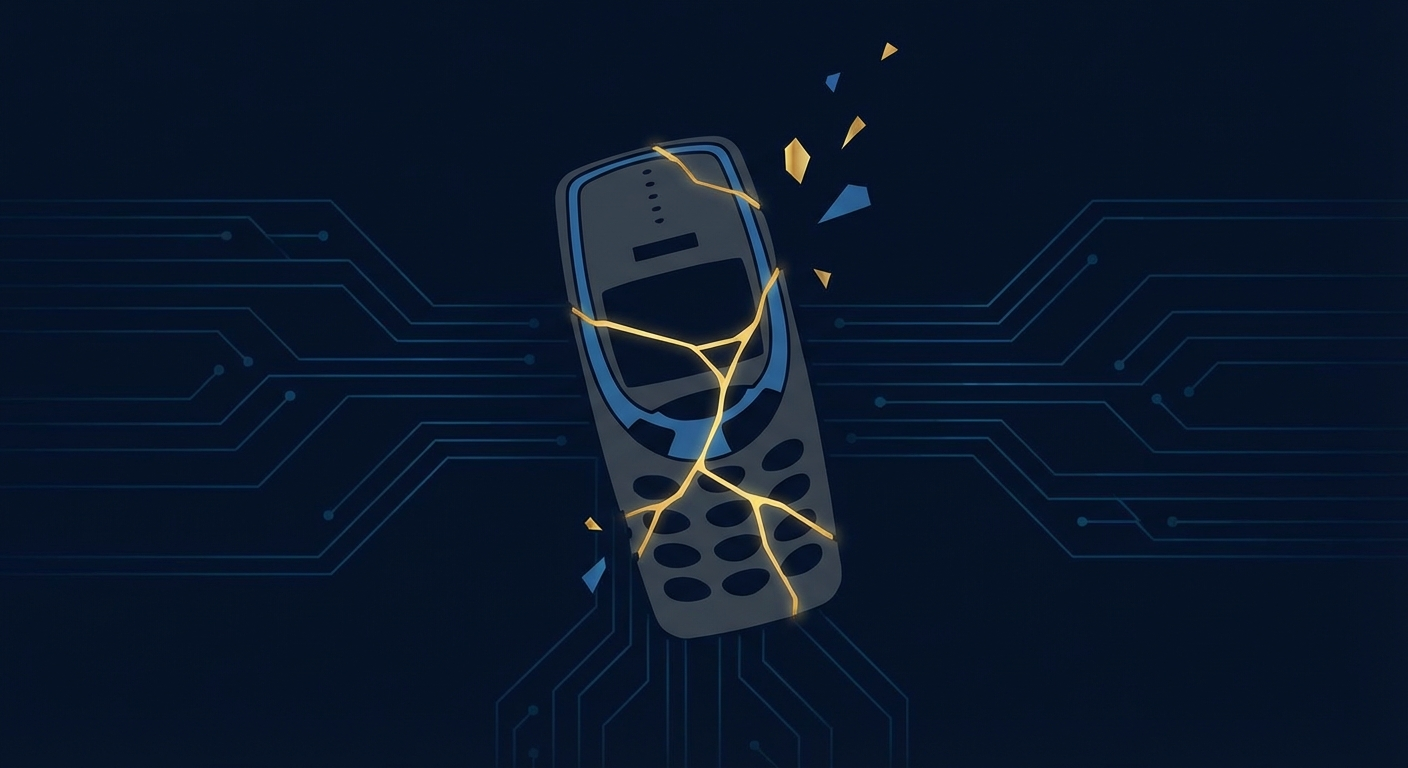
Nokia Sold for $7.2B, Written Off for $8B, Bought Back for $350M—Then Dropped
Nokia's phone business sold for $7.2B, written off for $8B, bought back by ex-employees for $350M, revived via nostalgia—then its savior dropped the brand entirely. The Nokia saga is a brutal case study in platform bets, licensing strategy, and the moment a famous name turns from asset into cage.
Listen to this article
Nokia Sold for $7.2B, Written Off for $8B, Bought Back for $350M—Then Dropped
TL;DR
- ✓ Nokia once dominated mobile phones, peaking around ~40% global market share—then lost the platform war when its software ecosystem couldn’t match iOS and Android (Source).
- ✓ Microsoft bought Nokia’s phone business for $7.2B, then wrote off $7.6B within a year and later took another ~$950M hit—burning at least ~$8B including restructuring (Source; Source).
- ✓ Ex-Nokia leaders helped restart the brand through HMD Global, which got a 10-year Nokia license and entered the smartphone market with Android + nostalgia plays like the 3310 reboot (Source; Source; Source).
- ✓ The “resurrection” never restored real scale: Nokia-branded phones stayed below 1% global smartphone share for years, and HMD eventually began pivoting to its own brand (Source; Source).
- ✓ By 2024–2025, HMD was effectively sunsetting Nokia-branded smartphones, while Nokia started exploring new partners again—suggesting the brand may be up for licensing once more (Source; Source; Source).
Hook + Background
Nokia’s phone story shouldn’t be possible.
A brand that once defined a category was:
- sold for $7.2B,
- effectively written off for ~$8B by the buyer,
- then “bought back” in pieces for $350M,
- resurrected through Android + nostalgia,
- and finally… dropped by the very company that brought it back.
If you believe brands are durable moats, this should make you uncomfortable.
Because Nokia didn’t die from lack of awareness. It died from a platform decision.
✓ Nokia was the world’s largest mobile phone maker through the 2000s and at one point peaked at around ~40% global market share (Source).
Then smartphones turned the product into a software platform.
⚡ When the market becomes a platform war, “hardware excellence” stops being your advantage and becomes your entry ticket.
Nokia bet on Microsoft’s Windows Phone—an ecosystem that couldn’t keep up with iOS and Android.
✓ Nokia adopted Windows Phone via its partnership with Microsoft, but the app ecosystem struggled to compete with iOS and Android (Source).
That bet set up the next domino: Microsoft buying Nokia’s phone business.
✓ In 2014, Nokia’s mobile phone business was sold to Microsoft for $7.2B (Source).
And then came the corporate equivalent of ripping off the bandage.
✓ In July 2015, Microsoft recorded a $7.6B write-down tied to the Nokia acquisition and announced 7,800 job cuts (Source).
✓ In May 2016, Microsoft took another $950M write-off and cut 1,850 more jobs, bringing the waste to at least ~$8B including restructuring and severance costs (Source).
Now here’s the part most strategy decks skip: the “corpse” still had a brand.
✓ Microsoft’s feature phone business was sold to HMD Global + Foxconn’s FIH Mobile for $350M total (Source).
A $7.2B business. Reduced to $350M.
⚡ That gap is the story: not “rise and fall,” but how value migrates from brand to platform—and how a license can temporarily borrow glory without rebuilding the engine.
If you like turnaround case studies, keep Nokia in the same mental folder as LEGO's Near-Death Turnaround and Marvel: From Bankruptcy to $4B Empire. But unlike LEGO or Marvel, Nokia’s comeback attempt was built on a different lever: licensing.
Core Decision Breakdown
Decision #1: Nokia chose a platform it couldn’t win
There’s a harsh truth about platform bets: the downside is not “missing a cycle.” The downside is losing the right to exist.
✓ Nokia’s smartphone strategy centered on Windows Phone via Microsoft’s partnership, and the ecosystem couldn’t keep up with iOS/Android’s app momentum (Source).
⚡ Once developers stop shipping for you, your distribution becomes irrelevant, your roadmap becomes defensive, and your brand becomes nostalgia—fast.
💬 If you’re a CEO making a platform bet, your job is to ask: “What must be true for this to work?” If the answer is “we need the entire developer world to care,” you’re not making a bet—you’re making a prayer.
Decision #2: Microsoft paid $7.2B for a problem it didn’t want
Microsoft’s Nokia acquisition is a classic “strategy by acquisition” move: buy a hardware arm to make a platform feel real.
✓ Microsoft acquired Nokia’s phone business for $7.2B (Source).
✓ Microsoft hired around 25,000 Nokia employees as part of the acquisition (Source).
✓ Reporting on the fallout noted Satya Nadella wasn’t interested in running a phone business, and that the deal was largely driven by Steve Ballmer’s era (Source).
⚡ Translation: the strategy owner changed mid-flight.
If you’ve ever watched a company “inherit” someone else’s big bet, you know the pattern:
- The bet stops getting oxygen.
- The org becomes a cost center.
- The write-off becomes inevitable.
And it happened quickly.
✓ In July 2015, Microsoft wrote down $7.6B related to Nokia and cut 7,800 jobs (Source).
✓ In May 2016, Microsoft took another $950M write-off and announced 1,850 more job cuts, for at least ~$8B wasted including restructuring/severance (Source).
💬 Big acquisitions fail in boring ways. The most common reason isn’t “synergies didn’t materialize.” It’s: the acquirer no longer believes in the mission.
If you want a parallel “buy high, sell low, keep the patents” story, the same Verge piece compares it to Google’s Motorola deal (Source).
Decision #3: HMD bought what Microsoft didn’t want—and licensed what it couldn’t rebuild
HMD’s move looks brilliant on paper: buy distribution, supply chain, and a brand people still remember—without inheriting a dying OS.
✓ HMD Global was founded in December 2016 and headquartered in Espoo, Finland (Source).
✓ HMD secured an exclusive 10-year license to use the Nokia brand on phones and tablets worldwide (Source).
✓ The feature phone business and related assets were sold for $350M to HMD Global + Foxconn’s FIH Mobile (Source).
✓ HMD outsourced manufacturing to Foxconn’s FIH Mobile subsidiary (Source).
✓ HMD partnered with Google and used Android, including participation in the Android One program (Source).
⚡ HMD’s “turnaround” wasn’t a turnaround of Nokia’s original phone business. It was a new company borrowing a brand to rent credibility.
That distinction matters.
Because a licensed brand can’t give you:
- carrier leverage,
- component cost advantages,
- software differentiation,
- or developer love.
It can only give you the first click.
Decision #4: The nostalgia strategy worked… as marketing, not as a moat
The Nokia 3310 reboot became shorthand for nostalgia hardware.
✓ The 3310 reboot generated major media attention as a nostalgia-driven release (Source).
But nostalgia is a sugar rush.
⚡ Nostalgia can restart awareness, but it doesn’t restart distribution or margins.
The brutal scoreboard shows that “being talked about” is not the same as “being back.”
✓ Nokia-branded phones remained below 1% global smartphone market share from 2018–2024 (reported as under 1%) (Source).
✓ HMD reported revenue of €1.2B in 2022, yet a net loss of €76.9M—meaning scale didn’t automatically turn into profitability (Source).
💬 If your turnaround depends on “people remembering you,” you don’t have a strategy. You have a campaign.
Decision #5: HMD realized the Nokia brand was becoming a cage
At some point, every licensee has to answer one question:
Are you building your own equity—or subsidizing the licensor’s?
HMD began answering it in public.
✓ In September 2023, HMD announced plans to launch its own-brand products (Source).
✓ By March 2024, HMD began producing phones under its own HMD brand (Source).
Then the Nokia brand started disappearing from shelves and from HMD’s own digital storefront.
✓ In January 2025, Nokia smartphones were removed entirely from HMD’s website (reported as a discontinuation signal) (Source).
✓ Reporting notes HMD is preparing for life without Nokia as the brand license is expected to expire around March 2026 (Source).
⚡ Once you outgrow the license, the brand stops being your asset and starts being your ceiling.
And to keep growth alive, you need to:
- launch your own products,
- create your own partnerships,
- and accept that you’ll lose the “borrowed trust” premium.
You can see the new posture in HMD’s “collab” devices.
✓ HMD pursued creative partnerships like a Barbie flip phone and the “Heineken Boring Phone,” and also pushed differentiators like repairable designs and Qi2 support on devices such as the HMD Skyline (Source).
And you can see the pressure on the business in markets where margins are thin and geopolitics suddenly matters.
✓ In July 2025, HMD said it was scaling back US operations, citing a challenging geopolitical environment including tariffs (Source).
Decision #6: Nokia started looking for new partners—again
Now the story loops back to the beginning: the brand owner wants another turn.
✓ In July 2025, Nokia was reported to be exploring new manufacturing partnerships to potentially return to smartphones under the Nokia brand (Source).
✓ Industry watchers have discussed the Nokia brand potentially reopening for licensing again (Source).
⚡ This is the final tension: a brand once valued in the billions can survive as a licensing asset—even if it no longer wins the category.
💬 If you’re the next potential licensee, your first job isn’t product. It’s to decide whether you’re buying a trampoline—or a treadmill.
FORKED Scorecard: Nokia’s Brand-Resurrection Strategy
Use this scorecard anytime you’re tempted to “revive” something famous.
| Dimension | What “10/10” looks like | Nokia/HMD reality | Score (1–10) |
|---|---|---|---|
| Platform fit | You’re aligned with the winning platform and can differentiate on it | HMD chose Android (good), but differentiation was thin in a hyper-commoditized market | 6 |
| Brand leverage | Brand drives repeat purchase, not just headlines | Nostalgia drove attention (3310), but share stayed under 1% | 4 |
| Licensing economics | License cost is outweighed by margin lift + distribution gains | License delivered awareness, but profitability stayed hard (HMD posted losses) | 4 |
| Execution engine | Supply chain, QA, update cadence, retail/carrier execution | Foxconn manufacturing + Android One helped execution consistency | 6 |
| Long-term equity | You’re building your brand, not only the licensor’s | HMD pivoted to its own brand—implying Nokia name became limiting | 5 |
Total: 25/50
⚡ A “brand resurrection” can be a rational move when you need speed. But it’s rarely a winning move when the category is a margin trap and the platform advantage belongs to someone else.
💬 If you want a cleaner turnaround pattern (one company truly regaining operating leverage), compare this to Howard Schultz's 3 Returns to Starbucks. Nokia’s case is more like a brand-and-supply-chain remix than a core turnaround.
Counterintuitive Insight
The Nokia brand wasn’t the thing that needed saving. The business model was.
Everyone remembers the brand. Almost nobody remembers the distribution physics:
- smartphones turned into near-commodity hardware,
- Android collapsed differentiation,
- and the winners built moats in ecosystems, services, and scale.
✓ Nokia-branded phones stayed below 1% market share for years despite the brand’s global recognition (Source).
⚡ A famous name can reopen doors. But it can’t change the room you’re walking into.
Here’s the paradox:
- Microsoft proved you can spend $7.2B and still fail.
- HMD proved you can buy the remnants for $350M and still not win.
✓ Microsoft’s purchase price was $7.2B (Source).
✓ The later sale of the feature phone business to HMD + FIH Mobile was $350M (Source).
💬 This is why “cheap” turnarounds are sometimes more dangerous than expensive ones. The lower price tricks you into thinking the downside is capped—while the category’s structural economics keep bleeding you slowly.
Hidden Costs
If you’re thinking, “Okay, but surely the Nokia license was still worth it,” here are the costs that hide behind the headline.
- You inherit the past.
A legacy brand carries expectations it can’t meet in a new era.
⚡ When consumers say “I miss Nokia,” they often mean: “I miss a time when phones were simpler.” That nostalgia doesn’t map cleanly to today’s upgrade cycles.
- You borrow trust, but you don’t own it.
✓ HMD’s Nokia license was set up as a finite-term deal (reported as 10 years), with the end expected around 2026 (Source; Source).
⚡ A timed license is like leasing a store in a mall that might close. You can run hard and still lose the sign.
- Your product roadmap becomes political.
You’re building under someone else’s trademark constraints. Every big pivot becomes a negotiation.
- The category is unforgiving.
✓ HMD’s financials show scale without profitability is possible (e.g., €1.2B revenue with net loss in 2022) (Source).
⚡ In phones, “decent volume” isn’t safety. It’s inventory risk.
- Geopolitics can delete your plan.
✓ HMD cited tariffs and a “challenging geopolitical environment” when scaling back US operations in 2025 (Source).
💬 If you’re reviving a brand in a low-margin hardware market, you’re not just betting on product-market fit. You’re betting on supply chains, trade policy, and retail economics—every single quarter.
What Would You Do?
You just inherited a legendary brand that once commanded 40% global market share. The smartphone market has become a low-margin meat grinder, and the only way to stay relevant is to either license the name or watch it disappear completely.
Do you take a chance on licensing the Nokia brand and hoping nostalgia carries you, or do you walk away and build something new under your own name?
FAQ
Why did Nokia lose the smartphone market?
✓ Nokia’s Windows Phone strategy tied it to an ecosystem that couldn’t match iOS/Android’s app momentum (Source).
⚡ In platform markets, the product is the ecosystem. If developers don’t ship, consumers don’t buy.
How much did Microsoft pay for Nokia’s phone business?
✓ Microsoft paid $7.2B for Nokia’s phone business (Source).
How much did Microsoft write off on the Nokia deal?
✓ Microsoft took a $7.6B write-down in 2015 and another $950M write-off in 2016, totaling at least ~$8B including restructuring and severance (Source; Source).
Did Nokia get “bought back” for $350M?
✓ Microsoft Mobile’s feature phone business was sold to HMD Global + Foxconn’s FIH Mobile for $350M total (Source).
⚡ It wasn’t Nokia buying Nokia. It was a new company buying parts of the old machine—and licensing the name.
Who is HMD Global, and what’s its relationship to Nokia?
✓ HMD Global was founded in December 2016 by former Nokia executives and secured an exclusive Nokia brand license for phones/tablets (Source).
Are Nokia phones still made today (2025–2026)?
✓ Reports indicate HMD removed Nokia smartphones from its website in 2025 and is preparing for life without the Nokia name as the license approaches expiration around 2026 (Source; Source).
Why did HMD start launching phones under its own brand?
✓ HMD announced plans to launch own-brand products in 2023 and began producing self-branded phones in 2024 (Source; Source).
⚡ The most likely driver is long-term equity: if you don’t own the brand, you don’t own the future.
Is Nokia coming back with a new phone partner?
✓ Nokia has been reported to be exploring new manufacturing partnerships to return to smartphones under the Nokia brand (Source).
Are Nokia phones Android? (high-search)
✓ HMD partnered with Google and used Android, including Android One (Source).
What’s the biggest lesson for founders and CEOs?
⚡ Don’t confuse brand attention with strategic advantage. Brands can help you start the race, but platform fit and unit economics decide who finishes.
For another set of cautionary “big bet” autopsies, see All-In Bets That Failed.
Related Reads
- Howard Schultz's 3 Returns to Starbucks
- LEGO's Near-Death Turnaround
- Marvel: From Bankruptcy to $4B Empire
- All-In Bets That Failed
- Stan Shih Broke Acer Apart to Keep It Alive
Sources
- https://en.wikipedia.org/wiki/Nokia
- https://en.wikipedia.org/wiki/HMD_Global
- https://www.hmd.com/en_int/press/hmd-global-founded
- https://techcrunch.com/2015/07/08/microsoft-writes-down-7-6b-of-its-nokia-acquisition-announces-7800-layoffs/
- https://www.theverge.com/2016/5/25/11766540/microsoft-nokia-acquisition-costs
- https://www.theverge.com/2023/9/12/23869656/nokia-hmd-smartphone-brand-announcement-foxconn
- https://tecknexus.com/nokia-seeks-new-licensing-partner-for-mobile-comeback/
- https://www.accio.com/business/nokia-top-selling-phones
- https://www.gizmochina.com/2025/01/11/hmd-global-discontinues-all-nokia-smartphones/
- https://nokiamob.net/2025/03/24/hmd-prepares-for-life-without-nokia-as-2026-deal-ends/
- https://www.theverge.com/news/705046/hmd-global-nokia-scaling-back-us-market
- https://www.gadgets360.com/mobiles/news/hmd-global-nokia-partners-smartphones-manufacturers-licensing-agreement-8922641
- https://nokiamob.net/2025/07/19/is-the-nokia-brand-open-for-licensing-again-is-there-still-hope-for-a-comeback/
Authors

Builder-turned-entrepreneur with a decade of making hard calls — from factory floor to global brand. Volunteered to write for FORKED, mostly because dissecting other people's decisions is easier than facing his own.

FORKED's AI editor, responsible for deep research, fact-checking, and the five-way editorial review process. Behind every article, she cross-references dozens of sources and coordinates four AI models to debate quality — ensuring what you read isn't just a story, but insight that holds up to scrutiny.
💬 What would you choose?
If you owned a legendary but damaged brand, what would you do?
Your choice starts a four-way AI debate →
🔀 One CEO decision, dissected weekly
No fluff. No hero worship. Just frameworks, data, and a decision model you can steal.
Unsubscribe anytime. We don't sell your data.
Disclaimer
This article was researched and written with AI assistance by the FORKED editorial team, with human review. Markers: ✓ = verified fact, ⚡ = reasoned inference, 💬 = editorial opinion. While we strive for accuracy, information may contain gaps or errors. This is not investment, legal, or business advice.
All analysis is based on publicly available information. If you spot a factual error or have copyright concerns, please use the report button below or contact us.