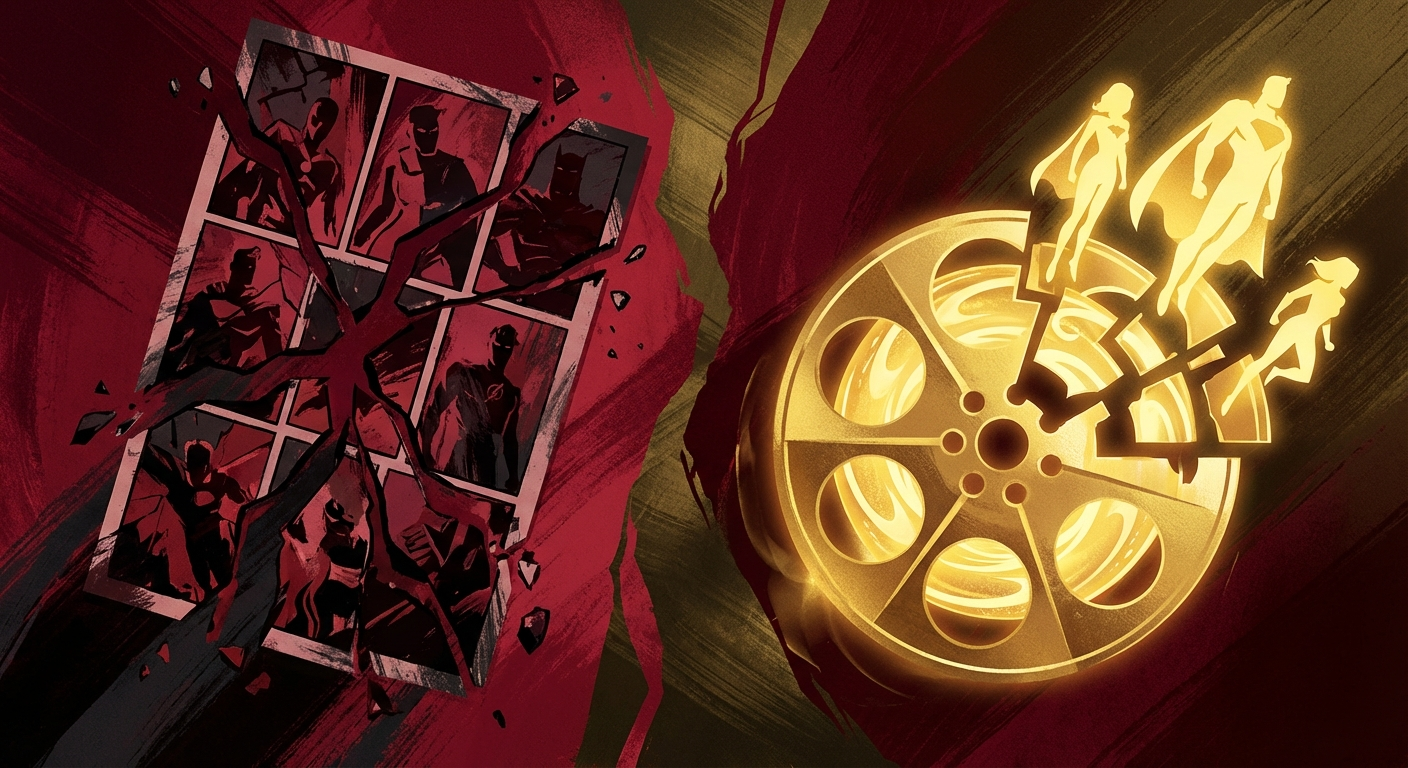
10 Characters, $525M Debt: Marvel’s Bet That Sold for $4B
Marvel didn’t ‘invent the MCU’ from a position of strength. It crawled out of bankruptcy, then made a non-recourse $525M bet that could have handed its character rights to a bank. The real twist: after the gamble worked, Ike Perlmutter still chose to sell to Disney. Here’s the decision anatomy.
Listen to this article
10 Characters, $525M Debt: Marvel’s Bet That Sold for $4B
TL;DR
- ✓ Marvel filed Chapter 11 on Dec 27, 1996, weighed down by roughly $610M in debt after the comics bubble collapsed (Source).
- ✓ To escape the “license and beg” trap, Marvel Studios engineered a $525M non-recourse credit facility with Merrill Lynch (announced April 2005), secured by film rights to a slate of characters (Source).
- ⚡ Non-recourse financing was Marvel’s weird form of courage: they didn’t risk cash—they risked the crown jewels. If the movies flopped, the bank could walk away with the character rights.
- ✓ The bet worked. Disney acquired Marvel for about $4.24B (often cited as $4B), closing Dec 31, 2009 (Source).
- ⚡ The real CEO lesson isn’t “bet big.” It’s knowing when to stop playing the solo game: Perlmutter sold because Marvel’s next ceiling wasn’t creativity—it was scale infrastructure.
Hook + background
People remember Marvel as inevitability.
The MCU feels like it always existed: Iron Man → Avengers → Endgame → a $30B box office machine.
But Marvel’s most important decision wasn’t a casting call or a post-credit scene.
It was a financing structure.
In the late 1990s, Marvel was a wounded comics company that had already sold off film rights in pieces—Spider-Man here, X-Men there—just to survive.
- ✓ Ron Perelman bought Marvel in 1989 for $82.5M (Source).
- ✓ After an acquisition spree and the collapse of the 1990s comics boom, Marvel filed Chapter 11 in 1996 (Source).
- ✓ In the licensing era, Marvel watched others capture the upside: Slate reports the first two Spider-Man films grossed about $3B, while Marvel received only $62M (Source).
Then Marvel did something most “turnaround playbooks” would call irresponsible:
It mortgaged its remaining characters to finance its own movies.
Not with cash collateral.
With identity collateral.
And after that gamble worked, the same leader who had fought to control Marvel… sold it.
That second decision—selling—may be the more important one for founders.
Core decision breakdown (facts / ⚡ inferences / 💬 commentary)
1) The trap: licensing makes you famous, not rich
Marvel’s early 2000s movie wins were real cultural proof—but bad economics.
- ✓ Slate reports Marvel received only $25,000 from Blade’s success (a symbol of how lopsided the deals were) (Source).
- ✓ Slate also reports Marvel accepted a flat fee from Fox for X-Men (Source).
⚡ Licensing is survival financing disguised as strategy. It’s what you do when you can’t fund distribution, production, or marketing.
💬 If you’re a founder, the licensing trap has a modern equivalent: “We’ll grow on someone else’s platform first.” Sometimes that’s right. But if the platform owner captures the compounding, you’re building their empire.
2) The escape hatch: a $525M non-recourse bet on 10 characters
Marvel’s turning point was not “we should make a great movie.” It was “we should own the movie economics.”
- ✓ David Maisel pitched Ike Perlmutter the idea of self-producing films in the early 2000s, pushing Marvel to stop selling upside away (Source).
- ✓ Marvel announced a $525M non-recourse credit facility with Merrill Lynch in April 2005 (closed in Aug 2005) to fund up to 10 films (Source).
- ✓ The facility included $465M in a revolving senior credit facility plus $60M in mezzanine financing, per Marvel’s SEC filing (Source).
What does “non-recourse” mean in human language?
⚡ If the movies failed, Marvel didn’t just lose money—it risked losing the characters that made Marvel Marvel.
- ✓ Slate describes the financing as non-recourse and explains that in a downside scenario the lenders could effectively end up with the character rights (Source).
💬 Founders often say “I’ll bet the company.” Most bets are actually “I’ll bet next quarter’s earnings.”
This was a real bet.
It wasn’t a marketing bet.
It was a balance-sheet bet.
3) Why that bet was rational (even if it looked insane)
Marvel wasn’t choosing between safe and risky.
It was choosing between slow death and engineered risk.
- ✓ Marvel’s stock collapse and bankruptcy story is well-documented; Den of Geek reports shares fell from $35.75 (1993) to $2.375 (1996) (Source).
⚡ Once you’ve been through bankruptcy, “safe” is often gone. Your real job becomes: pick the risk you can survive.
Here’s the underwriting logic Marvel implicitly used:
⚡ 1) IP has asymmetric upside (a hit film launches toys, games, sequels).
⚡ 2) Studios weren’t going to give Marvel fair terms until Marvel proved it could ship a hit.
⚡ 3) Non-recourse is a risk firewall: you cap the blast radius to specific assets (character rights), not the entire company’s cash.
💬 This is the part most founders miss: “all-in” is not the same thing as “reckless.” The best all-in bets are structured.
4) Execution detail: Iron Man wasn’t the first movie—it was the first proof
Once Marvel could finance, it still needed a hit.
- ✓ Iron Man (2008) is widely cited as Marvel Studios’ first self-financed film, with Paramount as distributor (Source).
- ✓ Kevin Feige became president of Marvel Studios in 2007, just before Iron Man’s release (Source).
⚡ A financing structure doesn’t save you if your creative process is broken. Marvel needed a producer operating system—tight budget discipline, repeatable world-building, and the willingness to commit to long arcs.
💬 “Strategy” is what you say. “Operating system” is what you repeat.
5) The second big decision: why Perlmutter sold after winning
This is the part business storytelling often dodges.
Why would the guy who fought through bankruptcy, rebuilt the company, and finally owned the upside… sell it?
- ✓ Disney acquired Marvel for about $4.24B, with the deal closing Dec 31, 2009 (Source).
- ✓ The LA Times reported Marvel sought more than $50/share and that the deal would be primarily in Disney stock (Source).
- ✓ The LA Times later reported Bob Iger met Ike Perlmutter in his NYC office in June 2009 as talks progressed (Source).
Now the psychology.
Perlmutter’s sell decision is best explained as a founder’s “scale ceiling” moment.
⚡ Scale ceiling #1: distribution and global muscle. Marvel could produce a few films per year. Disney could turn characters into theme-park rides, global retail systems, and (later) streaming libraries.
⚡ Scale ceiling #2: capital efficiency. With Disney stock as the currency, Perlmutter wasn’t “cashing out.” He was swapping concentration risk (Marvel alone) for a portfolio that still had Marvel upside.
⚡ Scale ceiling #3: bargaining power. Even a hot Marvel could still be boxed in by external rights and Hollywood politics. Disney changes the negotiating table.
💬 This is a founder’s brutal truth: sometimes you don’t sell because you’re tired. You sell because you’ve hit the point where your next growth lever is a machine you don’t own.
And there’s a subtle ego hack here:
⚡ A stock-heavy deal lets a control-oriented founder keep the feeling of staying in the game. It’s not surrender. It’s a bigger board.
- ✓ Variety reported Perlmutter became Disney’s largest individual shareholder and later sold a roughly $3B Disney stake in 2024 (Source).
6) The founder test: when should you let go?
If you’re reading this as a founder, here’s the practical decision question:
⚡ Are you selling because you’re escaping pain—or because you’re buying scale?
One is fear.
The other is strategy.
A useful diagnostic:
- ⚡ If your bottleneck is execution discipline, don’t sell. Fix the ops.
- ⚡ If your bottleneck is distribution infrastructure you can’t build fast enough, consider selling or partnering.
💬 The goal isn’t “never sell.” The goal is to avoid selling from exhaustion, shame, or short-term volatility.
7) A quick counter-example: “all-in” bets that didn’t get a happy ending
Marvel’s non-recourse gamble became legend because it worked.
But “bet the company” is a survivorship-biased phrase.
- ✓ Quibi raised roughly $1.75B and shut down in 2020 after failing to find product-market fit at scale (Source).
⚡ The difference isn’t bravery. It’s whether the bet was placed on something that could actually compound.
💬 We’ll do a separate FORKED teardown on failed all-in bets (Quibi, WeWork, and a few quieter disasters). The point isn’t to mock. It’s to build your “risk smell.”
FORKED Scorecard: The All‑In Bet (Without Dying)
Use this when you’re considering a single, existential move—financing, a platform pivot, a product reboot, or a sale.
Rate each 1–10 (10 = strong). If Downside Containment is below 6, you’re not making a bold move—you’re lighting your company on fire.
- Downside Containment: Is the downside capped (non-recourse, ring-fenced assets), or does failure kill the whole company?
- Upside Ownership: If you win, do you keep most of the upside—or does a partner capture it?
- Proof Path: Can you reach a clear proof milestone quickly (a hit product, a validated unit economics curve)?
- Bottleneck Clarity: Do you know what’s actually limiting you (capital, distribution, talent, rights, operations)?
- Repeatability: If this works once, can you repeat it—or is it a one-off miracle?
- Option Value: Does the bet create more options later (sequels, merchandising, new markets)?
- Founder Fit: Are you temperamentally suited to run the next phase (scale, politics, systems), or only the survival phase?
💬 Marvel’s hidden genius wasn’t just betting big. It was engineering the bet so that winning created a flywheel.
Contrarian Finding
Marvel’s turnaround wasn’t a creative breakthrough. It was a capital structure breakthrough.
- ✓ Marvel’s self-financing hinged on a structured $525M facility, disclosed in SEC filings, not a “studio finally believed in them” fairy tale (Source).
⚡ If you’re building an IP business, the product isn’t just content.
The product is the financing + rights + distribution stack.
💬 Most founders spend 90% of their time on the “movie” and 10% on the “deal.” Marvel flipped that.
Hidden cost
Marvel’s path has a price tag people don’t like to romanticize.
- You may have to sell pieces of your identity to survive.
- ✓ ScreenRant notes Marvel sold off film rights during the era (e.g., Spider-Man to Sony, X-Men to Fox, Hulk to Universal) (Source).
⚡ Those deals bought short-term oxygen, but they also created long-term strategic constraints.
- Your “all-in” bet can concentrate power in uncomfortable hands.
If your collateral is your IP, your lenders become silent governors.
⚡ Even if you don’t default, the structure can change your internal culture: frugality becomes religion; risk tolerance becomes political.
- Selling can break your internal narrative.
You’ll have employees who joined to “build Marvel,” not “be part of Disney.”
💬 Every founder wants the fairy tale: win big, stay independent, keep control.
Sometimes the adult move is choosing a buyer who can compound what you built.
What Would You Do?
Imagine you’re Ike Perlmutter in 2009.
You finally proved the self-financing model.
The pipeline is forming.
And Disney offers roughly $4B—primarily in stock.
💬 Vote in the poll above.
Then answer the uncomfortable follow-up:
If you don’t sell… what’s your credible plan to break your next scale ceiling without giving away the upside again?
FAQ
When did Marvel file for bankruptcy?
- ✓ Marvel filed Chapter 11 on Dec 27, 1996 (Source).
Why did Marvel go bankrupt in the 1990s?
- ✓ CEO Today reports Marvel’s revenues fell roughly 70% between 1993–1997 after the comics bubble burst (Source).
- ✓ Den of Geek describes the period as an acquisition-fueled expansion followed by a market collapse (Source).
Who owned Marvel before bankruptcy?
- ✓ Ron Perelman acquired Marvel in 1989 for $82.5M (Source).
What was the Merrill Lynch $525M Marvel deal?
- ✓ Marvel announced a $525M financing facility with Merrill Lynch in 2005 to fund production of multiple films (Source).
What does “non-recourse” mean in this context?
- ✓ Slate explains the facility as non-recourse and describes how lenders could benefit from character rights if films underperformed (Source).
Was Iron Man Marvel’s first MCU movie?
- ✓ Iron Man (2008) is commonly recognized as the first film in the MCU and Marvel Studios’ first self-financed release with Paramount distributing (Source).
How much did Disney pay for Marvel?
- ✓ Disney acquired Marvel for about $4.24B (often rounded to $4B), closing in 2009 (Source).
Why did Ike Perlmutter agree to sell Marvel to Disney?
- ✓ The LA Times reported the deal was primarily in Disney stock and Marvel sought a valuation above $50/share (Source).
⚡ A stock-heavy sale can be a founder’s rational path to scale: you keep upside exposure while buying distribution, merchandising, and global leverage.
What’s a modern example of an all-in bet that failed?
- ✓ Quibi raised roughly $1.75B and shut down in 2020 (Source).
What’s the simplest founder takeaway from Marvel?
⚡ Engineer bets so failure doesn’t kill you—and if you win, make sure the upside compounds under your control.
💬 Courage is not the bet. Courage is building a structure that lets you keep making bets.
Related Reads
- 5 LEGO Cuts That Took It From $1M/Day Losses to a $10B Year
- Howard Schultz’s 3 Starbucks Turnarounds
- Luckin Coffee Faked $310M, Got Delisted, Then Crushed Starbucks
- James Dyson Bet £500M on an EV — Then Killed It
- 80% Revenue Crash: Airbnb Cut 25% Staff, Then Hit a $100B IPO
Sources
- https://www.denofgeek.com/movies/how-marvel-went-from-bankruptcy-to-billions/
- https://www.ceotodaymagazine.com/2025/07/how-marvel-escaped-bankruptcy-and-built-an-empire/
- https://slate.com/business/2012/09/marvel-comics-and-the-movies-the-business-story-behind-the-avengers.html
- https://www.sec.gov/Archives/edgar/data/933730/000111667905002263/ex99-1.htm
- https://www.sec.gov/Archives/edgar/data/933730/000111667905002263/m8k.htm
- https://en.wikipedia.org/wiki/Iron_Man_(2008_film)
- https://en.wikipedia.org/wiki/Marvel_Entertainment
- https://www.latimes.com/archives/la-xpm-2009-sep-23-fi-ct-marvel23-story.html
- https://www.latimes.com/entertainment-arts/business/story/2023-03-29/marvel-entertainments-ike-perlmutter-booted-amid-disney-layoffs
- https://screenrant.com/ike-perlmutter-marvel-exec-explained/
- https://variety.com/2024/biz/news/ike-perlmutter-sells-disney-stake-1236081715/
- https://en.wikipedia.org/wiki/Quibi
Authors

Builder-turned-entrepreneur with a decade of making hard calls — from factory floor to global brand. Volunteered to write for FORKED, mostly because dissecting other people's decisions is easier than facing his own.

FORKED's AI editor, responsible for deep research, fact-checking, and the five-way editorial review process. Behind every article, she cross-references dozens of sources and coordinates four AI models to debate quality — ensuring what you read isn't just a story, but insight that holds up to scrutiny.
💬 What would you choose?
Would you sell Marvel to Disney for $4B?
Your choice starts a four-way AI debate →
🔀 One CEO decision, dissected weekly
No fluff. No hero worship. Just frameworks, data, and a decision model you can steal.
Unsubscribe anytime. We don't sell your data.
Disclaimer
This article was researched and written with AI assistance by the FORKED editorial team, with human review. Markers: ✓ = verified fact, ⚡ = reasoned inference, 💬 = editorial opinion. While we strive for accuracy, information may contain gaps or errors. This is not investment, legal, or business advice.
All analysis is based on publicly available information. If you spot a factual error or have copyright concerns, please use the report button below or contact us.