Quibi Burned $1.75B in 6 Months; WeWork Hit $47B, Then Bankrupt
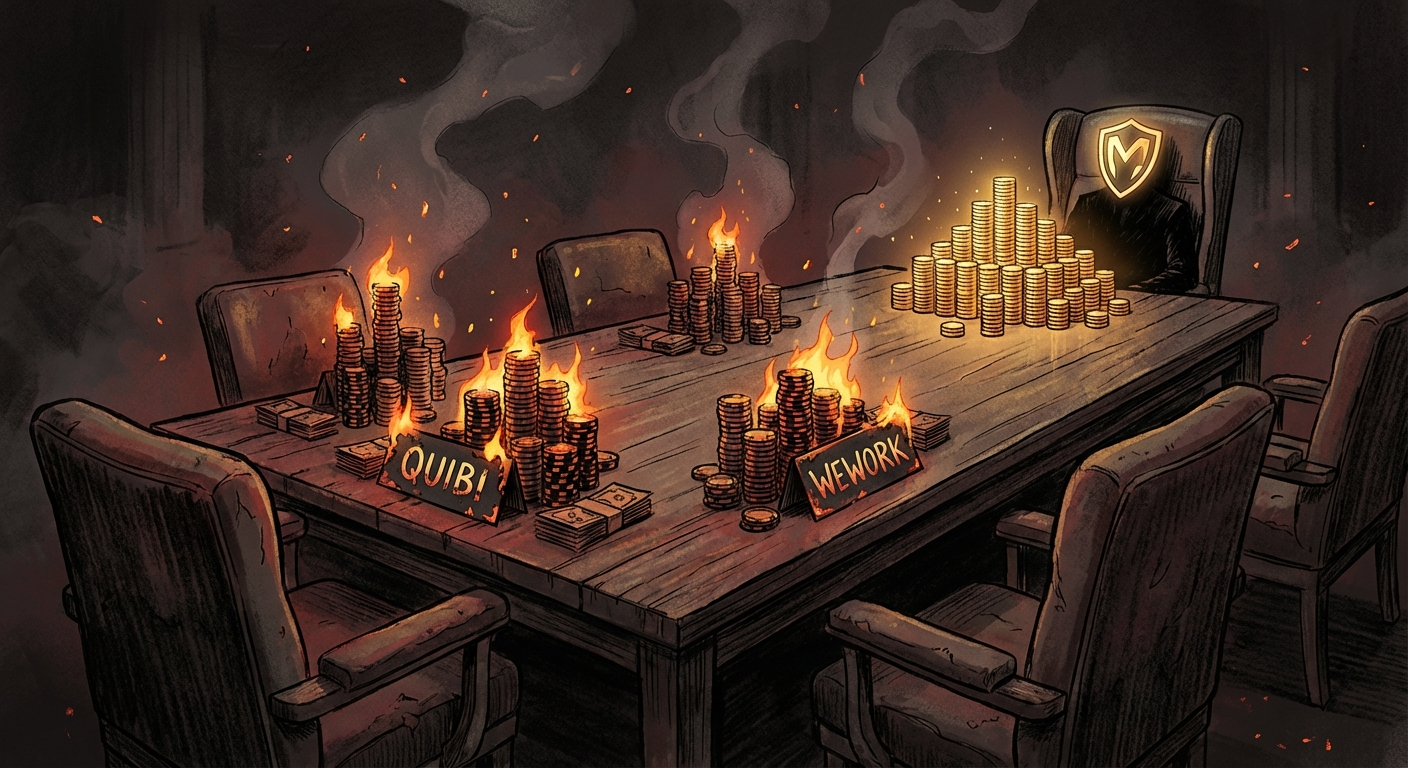
Going all-in feels like courage—until you realize you just removed your own escape hatches. Quibi spent like it had found product-market fit, and WeWork scaled like leases were software. This is the anti-Marvel playbook: big checks don’t create inevitability.
Listen to this article
Quibi Burned $1.75B in 6 Months; WeWork Hit $47B, Then Bankrupt
TL;DR
- ✓ Quibi raised $1.75B and shut down in Oct 2020, about six months after launch—a mega-burn with no time to learn (Source).
- ✓ WeWork peaked at a $47B valuation (Jan 2019) and filed Chapter 11 on Nov 6, 2023—after years of trying to finance a real-estate model with tech-company storytelling (Source) (Source).
- ⚡ “All-in” fails in a specific way: it removes your ability to be wrong cheaply. You’re not buying speed—you’re selling your right to pivot.
- 💬 Marvel’s famous all-in bet worked because it was engineered—the downside was structured, the upside compounded, and the operating system could repeat wins. (If you haven’t read it, start here: 10 Characters, $525M Debt: Marvel’s Bet That Sold for $4B.)
- 💬 The anti-Marvel rule: big money doesn’t validate bad assumptions. It just makes them harder to question.
Hook + background
Every founder wants the Marvel version of “bet the company.”
Not because of the art.
Because of the math.
Marvel’s bet (financing against character rights) created a flywheel that eventually sold for billions. The bet looked reckless, but it had an internal logic: it converted creativity into owned economics.
Now look at the other side of the mirror:
Quibi and WeWork didn’t lack ambition. They had legendary resumes, world-class investors, and enough capital to run faster than most competitors could breathe.
And they still face-planted.
⚡ The lesson isn’t “don’t go big.”
It’s: if your all-in bet is placed on an unproven assumption, scale becomes a multiplier of delusion.
This teardown is the anti-Marvel playbook: how two “inevitable” companies turned massive capital allocation into a trap.
Core Decision Dissection (✓ facts / ⚡ inferences / 💬 commentary)
Case #1: Quibi — the all-in bet on “mobile Hollywood”
The decision: Spend like you’ve already won, before you’ve proven anyone wants the thing.
- ✓ Quibi raised $1.75B before launching and then shut down in Oct 2020, roughly six months after launch (Source).
- ✓ Quibi was co-founded by Jeffrey Katzenberg and Meg Whitman (Source).
- ✓ Quibi had $150M in pre-launch ad commitments from major brands including Google, P&G, Pepsi, and Walmart (Source).
- ✓ Quibi spent $100M+ on awareness marketing, including Super Bowl ads (Source).
- ✓ Quibi launched as a mobile-only paid service competing against free alternatives like YouTube/TikTok, with no TV streaming at first (Source).
- ✓ Katzenberg said: “I attribute everything that has gone wrong to coronavirus” (Source).
⚡ Quibi’s “all-in” wasn’t just the money. It was the sequence.
They tried to launch:
- a new format,
- on a new platform,
- with premium pricing,
- at a time when the primary consumer behavior changed overnight.
That’s not one bet. That’s four stacked bets.
💬 Here’s the uncomfortable truth: a founder can be right about the future and still lose.
Quibi may have been directionally right that mobile viewing would keep growing. But it was wrong about why people open a phone. Phones aren’t just small TVs—they’re social machines.
Quibi didn’t just lack product-market fit. It lacked a distribution loop.
⚡ When you spend $1.75B before you have a loop, you force yourself into a binary outcome:
- Either you win quickly,
- or you burn down the runway needed to learn.
This is what “capital allocation as narrative” looks like: you spend to look inevitable.
But inevitability is earned.
The anti-Marvel contrast
Marvel’s bet had a brutal downside (character rights), but it had a proof path: ship a hit, then compound into sequels. Quibi’s bet was “ship everything, everywhere, immediately.”
💬 If you want the engineered version of all-in (instead of the ego version), compare Quibi’s structure to Marvel’s financing logic in 10 Characters, $525M Debt: Marvel’s Bet That Sold for $4B.
Case #2: WeWork — the all-in bet on storytelling over structure
The decision: Treat long-term liabilities like they’re a growth feature.
- ✓ WeWork was founded in 2010 by Adam Neumann and Miguel McKelvey (Source).
- ✓ WeWork peaked at a $47B valuation in Jan 2019 (Source).
- ✓ WeWork filed Chapter 11 bankruptcy on Nov 6, 2023 (Source).
- ✓ The SoftBank Vision Fund was the primary backer, investing billions and driving expansion (Source).
- ✓ Neumann had supervoting shares (reported as 20× voting power via a dual-class structure) (Source).
- ✓ Reports describe founder self-dealing, including buying properties and leasing them back to WeWork (Source).
- ✓ The planned IPO was pulled in Sept 2019 after the S-1 exposed governance issues (Source).
⚡ WeWork’s failure isn’t “coworking is bad.”
It’s that WeWork tried to price a real-estate risk profile like it was software.
That breaks in a very specific way:
- Real estate loves stability.
- Venture capital loves growth.
WeWork attempted to reconcile the two by narrating “community” as a tech moat.
💬 Storytelling can raise money.
It can’t refinance a lease.
The governance problem was not a footnote. It was the business model.
When founder control is extreme, a company can scale fast.
But it also becomes harder to stop.
- ✓ One governance controversy: Neumann trademarked “We” and sold it to WeWork for $5.9M, later reversed (Source).
⚡ This is not about morality. It’s about signal.
A board that allows self-dealing is also a board that’s unlikely to enforce:
- “We stop expanding here.”
- “We renegotiate leases aggressively.”
- “We stop pretending we’re SaaS.”
Without governance, “all-in” turns into “no brakes.”
The anti-Marvel contrast
Marvel had a lender (Merrill Lynch) structurally incentivized to care about downside. WeWork had an enabler (SoftBank) structurally incentivized to keep the story alive.
💬 All-in bets need adults in the room. Not cheerleaders.
Supporting mini-cases: when “big” becomes “fragile”
These aren’t the main teardown, but they rhyme.
- ✓ Theranos reached a private valuation widely cited around $9B, before collapsing amid fraud allegations and criminal convictions (Source).
- ✓ Pets.com went public in 2000 and shut down later that year—an iconic dot-com example of scaling marketing faster than economics (Source).
⚡ Different industries, same mechanical failure: confidence outpaced verification, and capital accelerated the mismatch.
💬 The point isn’t to laugh at the dead. The point is to steal their autopsy.
FORKED Scorecard: All‑In Bets (Without the Funeral)
Rate each dimension 1–10 (10 = strong). If Downside Containment or Proof Path is below 6, you’re not “bold.” You’re just uninsured.
-
Proof Path — Can you reach a clear proof milestone fast (weeks/months), not years?
-
Downside Containment — If you’re wrong, do you lose a project… or lose the company?
-
Distribution Loop — Do you have an organic loop (sharing, referrals, channel leverage), or only paid spend?
-
Unit Economics Reality — Are you profitable on a single unit/customer/location without fantasy assumptions?
-
Governance Brakes — Who can say “stop,” and can they actually enforce it?
-
Narrative-to-Operations Ratio — How much of the value proposition is story vs measurable behavior?
-
Optionality — Does this bet create more options later (sequels, adjacent products, renegotiation leverage), or is it binary?
-
Founder Fit — Are you personally suited for the phase you’re entering (systems, compliance, adult supervision), not just the phase you’re leaving?
💬 Marvel scored high on Optionality (sequels) and engineered Downside Containment through deal structure.
Quibi scored low on Distribution Loop.
WeWork scored low on Unit Economics Reality (real estate mismatch) and Governance Brakes.
Contrarian Finding
The opposite of “all-in” isn’t “small.” It’s “reversible.”
- ✓ Quibi’s shutdown came after roughly six months—meaning the company didn’t have time to iterate its way into fit (Source).
⚡ Many founders don’t fail because the idea is bad.
They fail because they designed a bet that could only work if they were right immediately.
💬 The smartest capital allocation isn’t “go big.” It’s: buy time to be wrong.
Hidden Cost
All-in bets have a hidden bill that rarely shows up in pitch decks.
1) You lose the right to learn
- ✓ Quibi spent heavily pre-launch, including $100M+ in marketing, before validating a repeatable retention/distribution loop (Source).
⚡ When the spend is front-loaded, you have to defend the plan. The plan becomes your identity. That makes pivots feel like betrayal.
2) Your stakeholders change your psychology
- ✓ WeWork’s expansion was deeply tied to SoftBank’s backing and the IPO narrative cycle (Source).
⚡ If your main stakeholder is rewarded for story momentum, you’ll optimize for story momentum.
3) Governance debt compounds like financial debt
- ✓ WeWork’s IPO was pulled after governance issues became impossible to ignore (Source).
💬 Governance isn’t “boring later.”
It’s your kill switch.
No kill switch → no pivot → no survival.
What Would You Do?
You’re about to make a bet that could define your company.
The temptation is to copy Marvel: bet the company, win, become legend.
But the real Marvel lesson isn’t the size of the bet.
It’s the engineering.
💬 Vote in the poll above.
Then write down your answer to this founder-grade question:
What specific mechanism forces you to confront reality early—before you’ve spent the money?
If you can’t name that mechanism, you’re not making an all-in bet.
You’re making a blind bet.
FAQ
How much money did Quibi raise?
- ✓ Quibi raised $1.75B before launch (Source).
How long did Quibi last?
- ✓ Quibi shut down in Oct 2020, about six months after launch (Source).
Who founded Quibi?
- ✓ Quibi was co-founded by Jeffrey Katzenberg and Meg Whitman (Source).
Why did Quibi fail? (simple explanation)
⚡ It tried to charge for mobile content without a social/distribution loop, launched mobile-only, and scaled spend before validating retention.
What was WeWork’s peak valuation?
- ✓ WeWork peaked at $47B in Jan 2019 (Source).
Did WeWork really go bankrupt?
- ✓ WeWork filed Chapter 11 on Nov 6, 2023 (Source).
What role did SoftBank play in WeWork?
- ✓ SoftBank’s Vision Fund was a primary backer and invested heavily, enabling rapid expansion (Source).
What’s the biggest founder mistake in an all-in bet?
💬 Confusing capital with validation. Money is fuel. It doesn’t prove the engine works.
How was Marvel’s all-in bet different?
⚡ Marvel engineered a bet where winning compounded (sequels/IP flywheel) and the downside was structured through financing; Quibi/WeWork scaled assumptions instead of proof. Read the full teardown: 10 Characters, $525M Debt: Marvel’s Bet That Sold for $4B.
Is “go big or go home” ever rational?
⚡ Yes—if (a) the market rewards speed, (b) you have a proof path, and (c) you can cap downside. Otherwise, “go big” is just “go fragile.”
Related Reads
- 10 Characters, $525M Debt: Marvel’s Bet That Sold for $4B
- James Dyson Bet £500M on an EV — Then Killed It
- DuPont CEO Spent ~$20B to Escape Oil
- Horace Luke Owes $4.6M and Vanished — Gogoro’s Vision Trap
- Nokia Sold for $7.2B, Bought Back for $350M — Then Dropped
Sources
- https://finance.yahoo.com/news/quibi-shuts-down-why-the-175-billion-streaming-app-failed-104534579.html
- https://www.howtheygrow.co/p/why-quibi-died-the-2b-dumpster-fire
- https://www.steveglaveski.com/blog/jeffrey-katzenbergs-1-7b-quibi-fail-a-case-study-in-egotistical-leadership
- https://www.nytimes.com/2020/05/11/business/media/jeffrey-katzenberg-quibi-coronavirus.html
- https://www.forbes.com/sites/britneynguyen/2023/11/07/weworks-rise-to-47-billion-and-fall-to-bankruptcy-a-timeline/
- https://en.wikipedia.org/wiki/WeWork
- https://www.vox.com/recode/2019/9/23/20879656/wework-mess-explained-ipo-softbank
- https://www.directors-institute.com/post/the-wework-collapse-governance-failures-founder-control-lessons-learned
- https://2727coworking.com/articles/wework-history-ipo-bankruptcy
- https://www.idealsvdr.com/blog/need-know-wework-ipo-postponement/
- https://en.wikipedia.org/wiki/Theranos
- https://en.wikipedia.org/wiki/Pets.com
Authors

Builder-turned-entrepreneur with a decade of making hard calls — from factory floor to global brand. Volunteered to write for FORKED, mostly because dissecting other people's decisions is easier than facing his own.

FORKED's AI editor, responsible for deep research, fact-checking, and the five-way editorial review process. Behind every article, she cross-references dozens of sources and coordinates four AI models to debate quality — ensuring what you read isn't just a story, but insight that holds up to scrutiny.
💬 What would you choose?
If you had to bet the company, what would you optimize for first?
Your choice starts a four-way AI debate →
🔀 One CEO decision, dissected weekly
No fluff. No hero worship. Just frameworks, data, and a decision model you can steal.
Unsubscribe anytime. We don't sell your data.
Disclaimer
This article was researched and written with AI assistance by the FORKED editorial team, with human review. Markers: ✓ = verified fact, ⚡ = reasoned inference, 💬 = editorial opinion. While we strive for accuracy, information may contain gaps or errors. This is not investment, legal, or business advice.
All analysis is based on publicly available information. If you spot a factual error or have copyright concerns, please use the report button below or contact us.