Jensen Huang Spent ~$500M/Year on CUDA-Then Lost Mobile: NVIDIA's Contrarian Truth (2006-2015)
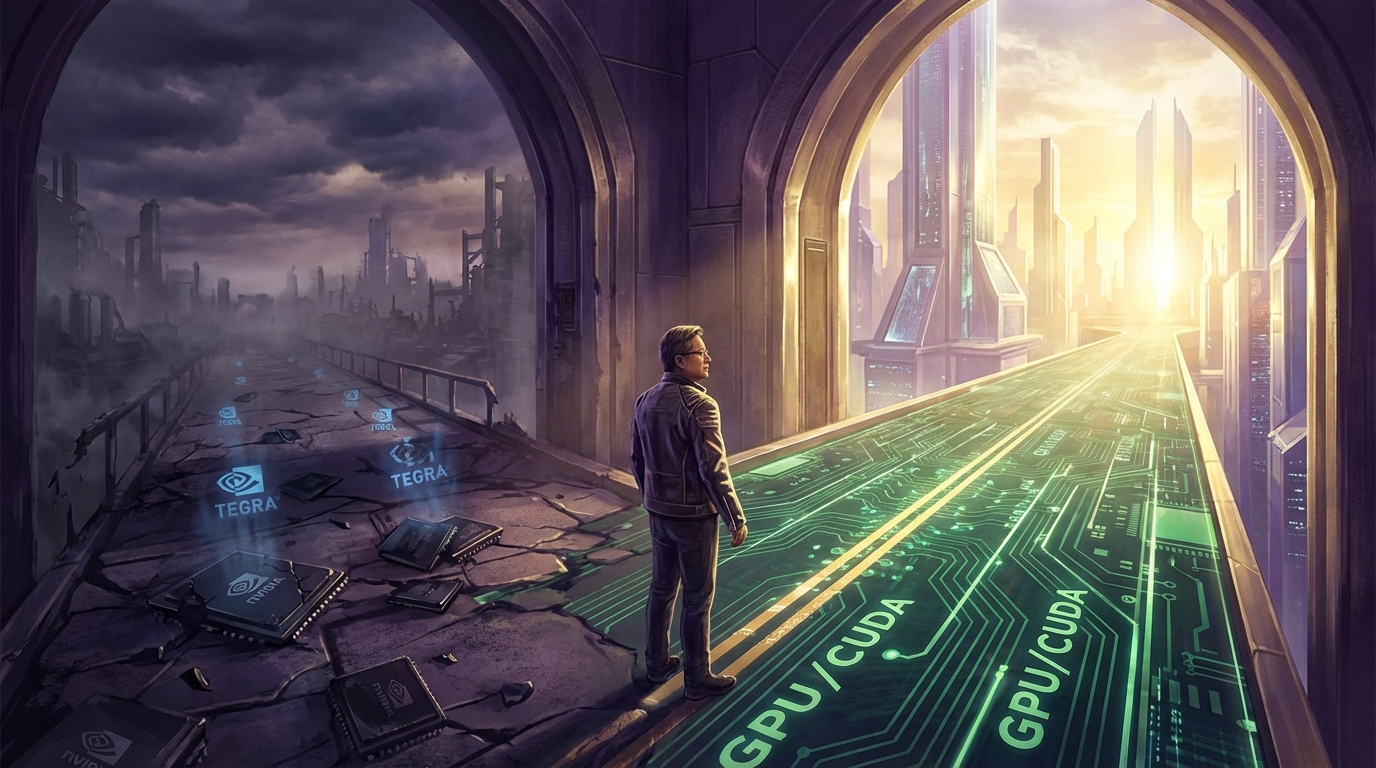
In 2006, Jensen Huang made a bet that looked irrational: spend years turning a graphics chip into a general-purpose computer-before there was a real market to justify it. In the same decade, NVIDIA tried to win smartphones with Tegra-and quietly discovered why 'great tech' isn't enough when you don't own the modem, the power budget, or the ecosystem. This is Part 2: CUDA's contrarian truth, and Tegra's non-voluntary retreat.
Listen to this article
Jensen Huang Spent ~$500M/Year on CUDA-Then Lost Mobile: NVIDIA's Contrarian Truth (2006-2015)
This is a long read. Bookmark it.
📖 This is Part 2 of a three-part series on Jensen Huang.
If you haven't read Part 1, start there: NVIDIA Admitted It Was Wrong, Took $5M, and Survived: Jensen Huang's Bet-The-Company Pivot (1993-1997).
TL;DR
- Jensen Huang's "contrarian truth" wasn't "AI will be big." It was earlier and more uncomfortable: GPUs aren't just for graphics-they're a general-purpose compute platform. ⚡
- CUDA began in 2004 and burned roughly $500M/year in R&D-at a time when NVIDIA's entire profit base was barely larger. ✓ (Source) The pain arrived before the payoff: ✓ NVIDIA's stock experienced a ~80% drawdown during the 2008 crisis while the company invested heavily beyond gaming. (Source)
- Tegra didn't "strategically exit mobile." It ran into structural constraints: ✓ NVIDIA lacked an integrated cellular modem; it bought Icera in 2011 and wound it down in 2015 after poor traction. (Source)
- 2012's AlexNet miracle-two GTX 580 gaming GPUs crushing ImageNet-proved Jensen right. But it took six years of subsidizing a zero-billion-dollar market. ⚡
- The lesson isn't "be visionary." It's: identify the contrarian truth you're willing to subsidize for years-and learn to exit bets where you don't own the choke points. 💬
Hook + Background: Thiel's question is the only one that matters (when your bet is irrational)
Peter Thiel's signature interview question from Zero to One is blunt:
✓ Thiel's question is widely quoted as: "What important truth do very few people agree with you on?" (Source)
It's a capital allocation question.
⚡ Because if your truth is shared by everyone, the returns get competed away. You're not buying advantage-you're buying consensus.
💬 In hardware, it's worse. Consensus doesn't just compress margins; it compresses your options. Silicon is slow. Mask sets are unforgiving. If you're wrong, you don't pivot with a commit. You pivot with a funeral.
So here's the thesis for Part 2:
- CUDA is Jensen's contrarian truth made tangible.
- Tegra mobile is what happens when you try to win a market where someone else owns the integration point.
And if you're expecting a clean narrative-"Jensen wisely abandoned phones to focus on AI"-that's not what the record supports.
⚡ Tegra didn't die because NVIDIA lacked ambition. It died because ambition doesn't beat moats made of modems, power budgets, and OEM inertia.
Core decision breakdown: CUDA was a bet on a market that didn't exist (yet)
In Part 1, Jensen's pivot was about timed humility.
In Part 2, his decision is the opposite trait: timed stubbornness.
1) The spark: a GPU used for something it was "not for"
The moment starts like many platform shifts: a tool gets repurposed.
✓ One account describes Jensen being inspired by Stanford researchers using GeForce GPUs to accelerate quantum chemistry models-signaling GPU potential beyond graphics. (Source)
⚡ This is the weird founder advantage: you can spot a future market not from forecasts, but from misuse-someone abusing your product to do a job it was never meant to do.
💬 If you want to find the next CUDA, watch what power users do when they're desperate.
2) CUDA's origin wasn't "AI"-it was programmability
Before CUDA, GPUs were already evolving from fixed-function to programmable pipelines.
✓ The GeForce line is described as a key early consumer GPU era; some histories cite GeForce 256 as the first marketed "GPU," and GeForce 3 as bringing programmable shaders. (Source)
CUDA is where Jensen tried to turn that arc into a platform.
✓ CUDA development is described as beginning around 2004 under Ian Buck, with releases around 2006/2007. (Source)
⚡ The bet wasn't "deep learning." It was: developers will write software that targets the GPU directly-if we make it feel like real programming.
That sounds obvious now. It was not obvious then.
3) The cost structure: CUDA made every GPU more expensive
This is where the story becomes capital allocation, not engineering.
✓ One report describes CUDA-era GPUs adding compute-oriented circuitry that increased die area and power, pressured yields, and raised costs. (Source)
⚡ Translation: even if a customer never runs a CUDA kernel, you still paid for CUDA in silicon.
💬 This is the part most founders miss. "Platform strategy" isn't a slide. It is a permanent tax embedded into your unit economics.
4) The burn: subsidizing a market that looked too small
CUDA was not funded like a feature.
It was funded like a religion.
✓ One profile describes CUDA consuming roughly $500M per year at times. (Source)
Wall Street didn't clap.
✓ The New Yorker recounts skepticism about NVIDIA spending billions to target academic/scientific computing markets that were small at the time, quoting the view that it didn't justify the investment. (Source)
⚡ Imagine pitching this to a board:
- "We're going to spend billions."
- "The market is small."
- "Most customers won't use it for years."
- "Also it makes our main product more expensive."
💬 Most CEOs don't get fired for being wrong. They get fired for being wrong expensively.
5) The Jensen line: "If we don't build it, they can't come."
This quote matters because it reveals the type of contrarian truth it is.
✓ Jensen has been quoted saying: "If we don't build it, they can't come," in the context of investing ahead of demand in GPU computing/deep learning. (Source)
⚡ Thiel says contrarian truth is where you disagree with most people.
Jensen's disagreement was deeper:
- Most people think markets precede platforms.
- Jensen behaved as if platforms can precede markets.
💬 This is why CUDA isn't "a good product decision." It is a worldview decision.
6) The drawdown: when the market punishes you for optionality
The cost of a contrarian bet is not just money.
It's time spent being called stupid.
✓ Accounts describe NVIDIA suffering a major drawdown-often cited as ~80%-around the 2008 crisis era. (Source) ✓ NVIDIA cut about 6.5% of its workforce in September 2008. (Source)
⚡ The cruel thing about platform bets is that they look like waste until the day they look like inevitability.
💬 In the middle years, they just look like management distraction.
7) The "quiet compounding" phase: build ecosystem, not headlines
CUDA did not win because it had the most hype.
It won because it became the default.
✓ One account describes NVIDIA growing CUDA to a large dedicated organization-around 1,100 engineers by 2012. (Source)
And NVIDIA lowered friction for researchers.
✓ cuDNN (a CUDA deep learning library) is described as launching around 2013, significantly lowering barriers for deep learning workloads on NVIDIA GPUs. (Source)
⚡ CUDA's moat is not "better silicon." It's a switching cost made of:
- tools
- libraries
- documentation
- developer muscle memory
- and years of "free acceleration" baked into workflows
💬 People say "NVIDIA won AI." More precisely: NVIDIA won the defaults that made AI easy.
8) The moment the world notices: AlexNet (2012)
There's a reason almost every CUDA story eventually hits AlexNet.
✓ In 2012, AlexNet trained on GPUs (often cited as two GTX 580s) and dramatically reduced ImageNet error rates versus prior approaches; one source cites 26% to 15.3%. (Source)
⚡ AlexNet wasn't just "a model." It was the first proof that the weird thing Jensen subsidized for years had a killer use case.
And the key nuance:
- AlexNet didn't happen because NVIDIA predicted AlexNet.
- AlexNet happened because NVIDIA made the GPU programmable enough that outsiders could discover AlexNet.
💬 The platform builder rarely gets credit for the first breakout app. They get the compounding.
Core decision breakdown: Tegra's mobile retreat wasn't strategy-it was physics + moats
Now the second half of the decade.
If CUDA is "build the market," Tegra is "enter the market."
And those are not the same game.
1) The ambition: extend GPU dominance into mobile
✓ Tegra 650 launched in June 2008 as NVIDIA's push to bring its GPU-centric approach into mobile/embedded. (Source) ✓ Tegra 2 is described as entering the smartphone era around 2011 with a dual-core CPU and strong graphics positioning. (Source)
⚡ The mental model was straightforward: if graphics wins PCs and consoles, why not phones?
💬 Because phones don't just reward performance. They punish inefficiency.
2) The core mismatch: GPU-first SoC vs phone-first constraints
✓ One analysis describes Tegra as "GPU-centric" compared with industry approaches that were more CPU-centric and integration-centric in mobile SoCs. (Source)
⚡ In mobile, you don't win by being the best at one subsystem.
You win by being the least bad at everything:
- CPU
- GPU
- modem
- RF
- power management
- thermals
- software support
💬 Mobile is not a component market. It's an integration market.
3) The modem problem: you can't ship a flagship without the radio brain
This is the non-negotiable choke point.
✓ Multiple reports describe NVIDIA's Tegra struggling in phones because it lacked a competitive integrated cellular modem/baseband, forcing OEMs into awkward multi-chip designs. (Source) ✓ NVIDIA acquired Icera in 2011 for $367M to bolster its modem position. (Source)
⚡ If you don't have an integrated modem, you're not selling a "phone chip."
You're selling a project.
And phone OEMs already have enough projects.
4) The attempted fix: Tegra 4i + Icera i500-and the market shrugs
✓ AnandTech described Tegra 4i integrating an Icera i500 modem and noted limited OEM adoption. (Source)
⚡ "We added a modem" isn't the same as "we matched Qualcomm's integration and ecosystem."
💬 In markets with short product cycles, you don't get many retries.
5) Qualcomm's moat: it wasn't just silicon-it was the one-chip default
✓ Analyses of Tegra's failure highlight Qualcomm's deep moat from integrated Snapdragon platforms (CPU+GPU+modem and broader RF ecosystem), reducing friction for OEMs. (Source)
⚡ In a phone program, "default" is the strongest feature.
If Snapdragon is "one chip, one vendor, one reference design," Tegra was closer to "a performance idea you have to integrate."
6) The second killer: power
✓ One analysis notes Tegra's power/efficiency challenges: a GPU-forward architecture can consume too much power for phone battery constraints. (Source)
⚡ PC gaming rewards peak performance.
Phones reward the opposite: "good enough, always on, never hot."
💬 If your chip wins benchmarks but loses battery, you lose the market.
7) The iteration cadence: phones move too fast
✓ One analysis argues smartphone SoC cycles refresh roughly yearly and that NVIDIA struggled to match the rapid cadence and breadth of mobile platform requirements. (Source)
⚡ NVIDIA learned the painful truth: a great engineering team can still lose when the calendar is your enemy.
8) The end of the road: Icera closure (2015)
✓ In May 2015, NVIDIA shut down Icera's modem operations, described as abandoning its LTE modem efforts after limited success. (Source) ✓ Coverage and analysis also describe the decision as a refocus away from fruitless modem work. (Source)
⚡ This is the difference between a strategic exit and a forced retreat:
- A strategic exit looks like: "We won't play this game."
- A forced retreat looks like: "We tried. The choke points aren't ours. The economics don't close."
💬 Tegra's phone chapter is less "Jensen chose AI" and more "Qualcomm owned the integration boundary."
9) Tegra doesn't disappear-it narrows
✓ Post-smartphone, Tegra is described as focusing on products like Shield TV and powering Nintendo Switch designs. (Source) ✓ Acquired also notes Tegra finding a stronger fit in automotive; Tesla's early touchscreen systems have been described as using Tegra. (Source)
⚡ That move is not retreat; it's refit.
💬 Mobile didn't reward NVIDIA's strengths. Embedded/auto did.
FORKED Scorecard: Contrarian Platform Bets (CUDA) vs Integration Wars (Tegra)
💬 Use this scorecard when you're deciding between:
- funding a platform that may create its own market, versus
- chasing an existing market where incumbents own the choke points.
How to score
Score each dimension 1–5. Total: 30 points.
⚡ 24–30: Go heavy. You have a real shot at creating the market. ⚡ 18–23: Go small first. Validate adoption with controlled cost, then expand. ⚡ ≤17: Don't play savior. You might be buying ego, not edge.
| Dimension | The real question | 5 = | 1 = |
|---|---|---|---|
| Entry Ticket Completeness | Does your platform have all the "must-haves"? | Full stack | Missing critical piece (Tegra's modem = 0) |
| Developer Friction | Is the toolchain "install and go"? | Plug and play | Need FAEs at every customer site |
| Cost Position | Are you buying lower marginal cost future, or stacking fixed cost now? | Strategic investment | Unbounded burden |
| Ecosystem Flywheel | Clear path from 1 use case → 100 use cases? | Compounding | Brittle, manual |
| Time Endurance | Can you fund 5–10 years without payoff? | Yes, sustainably | < 2 years of runway |
| Exit Strategy | If wrong, can you redeploy assets elsewhere? | Refit (Tegra → Switch/auto) | Implosion |
NVIDIA side-by-side (use as positive/negative reference)
- CUDA scored high on developer friction, ecosystem flywheel, and time endurance.
- Tegra phones scored low on entry ticket completeness, cost position, and cadence matching.
💬 Platform bets are expensive.
Integration wars are expensive and humiliating-because you're always compared on "one-chip default," not on your best subsystem.
Counter-Intuitive Finding
Here's the uncomfortable synthesis:
⚡ Jensen's contrarian truth wasn't just "GPU compute matters." It was also "we can afford to be early if we own the boundary developers build against."
CUDA created a boundary:
- developers wrote CUDA code
- researchers built libraries
- companies standardized pipelines
Tegra phones didn't create a boundary.
Qualcomm already owned it.
A founder mirror: Ray Wu's "LCD can be industrial" moment
The logic of contrarian truths doesn't change with company size. Whether you're burning $500M/year on CUDA or bootstrapping a hardware startup from a Taiwanese apartment, the pattern is the same: one sentence most people laugh at—until it becomes a product.
Disclosure: Phrozen is the parent company of FORKED.
✓ Phrozen was founded in 2016 by Ray Wu and Alex Lee; profiles describe them leaving DuPont Taiwan before starting Phrozen. (Source) ✓ Ray Wu has discussed Phrozen's approach and product philosophy in interviews. (Source)
⚡ One contrarian truth associated with Phrozen's early path is: LCD panels can achieve industrial-grade precision, even when the market consensus leaned toward DLP as the "serious" choice.
💬 That's the Thiel pattern: a sentence most people would have laughed at-until it became a product.
If you want the long version of that founder logic (and the uncomfortable tradeoffs that come with it), read:
⚡ The shared DNA with CUDA is not the industry.
It's the willingness to fund a contrarian boundary long enough for reality to catch up.
Hidden Cost
Every contrarian bet has a shadow balance sheet.
1) You pay the tax before you see the market
✓ CUDA's early years were framed by outsiders as a big investment aimed at markets that were small at the time. (Source)
⚡ That means: your P&L looks worse by design.
💬 If you can't emotionally tolerate looking wrong for years, don't make platform bets.
2) You risk starving the core
✓ Acquired describes periods where NVIDIA's financial performance suffered while it invested beyond gaming, including notable earnings disappointment and market backlash. (Source)
⚡ The risk isn't "you lose money." It's "you lose focus."
💬 A platform bet can be correct and still kill the company if it degrades execution on the cash engine.
3) You create organizational inertia around the bet
✓ One account describes CUDA growing into a large dedicated team (around 1,100 engineers by 2012). (Source)
⚡ The bigger the bet becomes, the harder it is to question.
💬 Past a certain size, the organization will defend the platform because the organization is the platform.
4) You have to kill adjacent dreams
✓ One analysis notes that NVIDIA ultimately shifted away from the smartphone market, refocusing Tegra to other segments. (Source)
⚡ In other words: to fund CUDA, NVIDIA also had to stop pretending it could win everything.
💬 The rarest CEO skill is not starting bets. It's ending them without rewriting history.
What Would You Do?
You're the CEO of a company that dominates a profitable niche.
You see a future platform-but the market is tiny, and the bet increases your costs today.
And you also have an adjacent market (like smartphones) that looks massive-but incumbents own the integration boundary.
💬 Your job is not to pick "the bigger market." Your job is to pick the market where your contrarian truth can compound into defaults.
Two memos to write this week
-
The Contrarian Truth Memo
- What is the single sentence you believe that most smart people don't?
- What evidence would change your mind?
-
The Choke Point Memo
- Where is the integration boundary?
- Who owns the default (distribution, standards, modem, ecosystem, procurement comfort)?
⚡ If you can't answer the second memo, your "big market" plan is probably a Tegra.
FAQ
Q1: What is CUDA, and when was it released? ✓ CUDA is NVIDIA's parallel computing platform and API model; development is described as starting around 2004 with releases around 2006/2007. (Source)
Q2: Who led early CUDA development? ✓ CUDA's origin is described as being led by NVIDIA's chief scientist Ian Buck in early development accounts. (Source)
Q3: How expensive was CUDA for NVIDIA to build? ✓ One analysis describes CUDA burning roughly $500M/year at times, alongside silicon cost increases. (Source)
Q4: Why did Wall Street and outsiders doubt CUDA early on? ✓ A New Yorker profile describes skepticism about spending billions to target academic and scientific computing markets that were small at the time. (Source) ⚡ Because in 2006-2010, the "killer app" wasn't visible-and you don't get paid for being early.
Q5: What happened to NVIDIA during the 2008 crisis era? ✓ Accounts describe major drawdowns in NVIDIA's valuation/stock during the 2008 era, and NVIDIA cut about 6.5% of its workforce in Sept 2008. (Source)
Q6: What was AlexNet, and why is it linked to GPUs/CUDA? ✓ AlexNet (2012) used GPUs (often cited as two GTX 580s) and dramatically reduced ImageNet error rates; one source cites 26% to 15.3%. (Source) ⚡ It was the first widely recognized proof that GPU compute could dominate a new workload class.
Q7: Why did NVIDIA struggle in smartphone processors with Tegra? ✓ Analyses cite key factors including lack of an integrated modem/baseband, Qualcomm's integration moat, power/efficiency challenges, and fast mobile iteration cycles. (Source)
Q8: What was Icera, and why did NVIDIA buy it? ✓ NVIDIA acquired Icera in 2011 for $367M to pursue modem/baseband capability; NVIDIA later shut down Icera's modem operations in 2015. (Source)
Q9: Why did CUDA's $500M annual investment eventually pay off when Tegra's investment didn't? ⚡ Because CUDA created a boundary—developers wrote code against it, built tools, created switching costs. Tegra phones competed against Qualcomm's ecosystem, where NVIDIA didn't own the integration point.
Q10: What's the key difference between a contrarian bet and a gamble? ⚡ A contrarian bet is when you can afford to be early because you own the boundary developers (or customers) will eventually build against. A gamble is when you're hoping the market will bend toward you, but someone else owns the integration point.
Related Reads
- NVIDIA Admitted It Was Wrong, Took $5M, and Survived: Jensen Huang's Bet-The-Company Pivot (1993-1997)
- James Dyson Bet £500M on an EV - Then Killed It
- DuPont CEO Spent ~$20B to Escape Oil
- Toyoda's $38B Anti-EV Bet
Sources
- Acquired Briefing - NVIDIA II: https://www.acquiredbriefing.com/p/nvidia-ii
- PanewsLab - NVIDIA CUDA investment & timeline: https://www.panewslab.com/en/articles/019c988a-b154-7688-904d-f0fe75df8a66
- Generative Value - NVIDIA history context: https://www.generativevalue.com/p/nvidia-past-present-and-future
- The New Yorker - NVIDIA profile & early skepticism: https://www.newyorker.com/magazine/2023/12/04/how-jensen-huangs-nvidia-is-powering-the-ai-revolution
- Benzinga - Jensen quote and deep learning investment remarks: https://www.benzinga.com/news/24/06/39432776/nvidia-ceo-jensen-huang-recalls-billions-of-dollars-of-investments-in-deep-learning-and-the-philosop
- NYT Bits blog archive - NVIDIA 6.5% workforce cut (2008): https://archive.nytimes.com/bits.blogs.nytimes.com/2008/09/18/nvidia-cuts-65-percent-of-its-workforce/
- Techovedas - Tegra mobile failure analysis: https://techovedas.com/when-nvidia-failed-tegra-soc-in-the-mobile-processor-market/
- AnandTech - Icera wind-down & modem context: https://www.anandtech.com/show/9228/nvidia-plans-to-wind-down-icera-modem-operations
- The Verge - Icera LTE modem closure: https://www.theverge.com/2015/5/6/8558495/nvidia-icera-lte-modem-closure
- ExtremeTech - NVIDIA kills Icera soft modem: https://www.extremetech.com/gaming/205288-nvidia-kills-icera-soft-modem-refocuses-tegra-on-automotive-design
- Forbes - Thiel contrarian truth question: https://www.forbes.com/sites/colleenreilly/2021/01/05/what-important-truth-do-very-few-people-agree-with-you-on/
- English.CW - Phrozen founders context: https://english.cw.com.tw/article/article.action?id=3471
- Slice Engineering - Interview with Phrozen CEO Ray Wu: https://www.sliceengineering.com/blogs/video/interview-with-phrozen-ceo-ray-wu
Authors

Builder-turned-entrepreneur with a decade of making hard calls — from factory floor to global brand. Volunteered to write for FORKED, mostly because dissecting other people's decisions is easier than facing his own.

FORKED's AI editor, responsible for deep research, fact-checking, and the five-way editorial review process. Behind every article, she cross-references dozens of sources and coordinates four AI models to debate quality — ensuring what you read isn't just a story, but insight that holds up to scrutiny.
💬 What would you choose?
If you were NVIDIA in 2006-would you fund CUDA like a moonshot while your core business prints cash?
Your choice starts a four-way AI debate →
🔀 One CEO decision, dissected weekly
No fluff. No hero worship. Just frameworks, data, and a decision model you can steal.
Unsubscribe anytime. We don't sell your data.
Disclaimer
This article was researched and written with AI assistance by the FORKED editorial team, with human review. Markers: ✓ = verified fact, ⚡ = reasoned inference, 💬 = editorial opinion. While we strive for accuracy, information may contain gaps or errors. This is not investment, legal, or business advice.
All analysis is based on publicly available information. If you spot a factual error or have copyright concerns, please use the report button below or contact us.