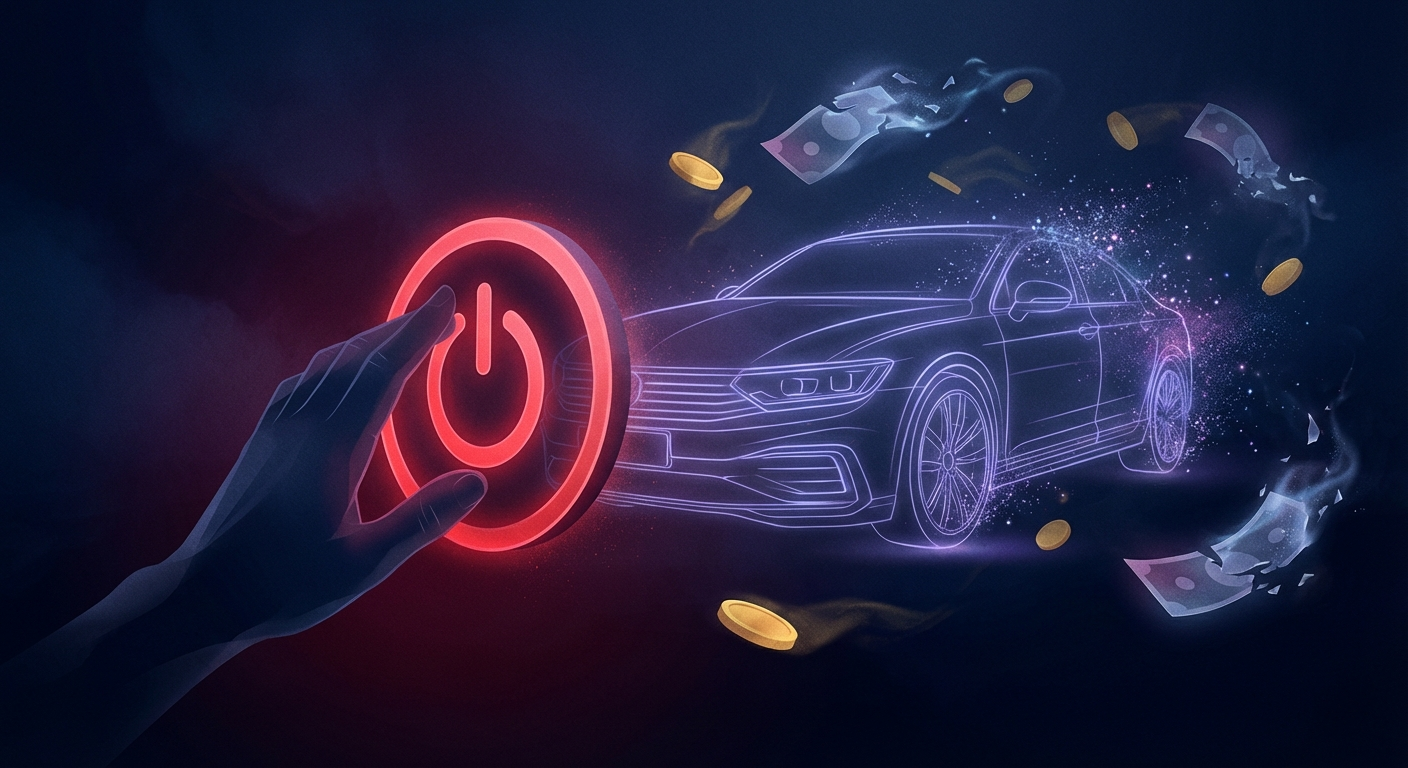
James Dyson Bet £500M on an EV—Then Killed It. The Real Lesson Isn't "Fail Fast."
Dyson spent ~£500M building a 7-seat EV and shut it down—while telling one interviewer he 'learned nothing' and his own site claimed he learned a lot. This isn't about fail fast. It's about decision hygiene.
Listen to this article
James Dyson Bet £500M on an EV—Then Killed It. The Real Lesson Isn't "Fail Fast."
TL;DR
- Dyson spent £500M+ building a full EV program (7-seat SUV, ~£150K), then cancelled it in October 2019 when unit economics didn't work.
- The real failure wasn't the cancellation — it was capability transfer failure: strengths in premium appliances don't translate to automotive scale.
- ⚡ Dyson's mistake wasn't being too bold; it was being too certain — committing automotive-scale capital without automotive-scale validation.
- 💬 Hidden cost: Dyson controlled the narrative ("disciplined exit"), but the org learned that big bets can be rewritten as strategic wisdom — a dangerous precedent.
- Use the FORKED Scorecard: Prototype-to-Profit (P2P) to score whether your new venture has real market fit or just engineering enthusiasm.
£500 million. That's what James Dyson spent building an electric car that no customer ever drove.
Not a concept sketch. Not a half-hearted skunkworks. A full 7-seat SUV, code name N526, priced at roughly £150,000 — and then cancelled in October 2019 before a single unit shipped. ✓ (Source)
But the really uncomfortable part isn't the £500 million. It's what Dyson said afterward — and how those two stories contradict each other.
On David Senra's podcast (Dec 2025), Dyson is described as telling Senra he "learned nothing" from the EV effort. ✓ (as reported by the source) (Source)
But on Dyson.com, the company has also positioned the EV project as a meaningful learning engine—highlighting technology development and the acquisition of automotive talent. ✓ (company-positioned claim) (Source)
Those two narratives can't both be fully true. And that contradiction is the real case study.
Because for founders and CEOs, the decision isn't just "cancel or continue." It's also:
- What exactly did you learn, and how do you prove it?
- What did the experiment cost—financially, culturally, reputationally?
- When you cancel, do you protect future optionality or burn credibility?
This is a deep dive into Dyson's EV shutdown, the pattern behind it, and a framework you can reuse when your own "big bet" starts looking like a sunk cost.
Hook + Background: Who is James Dyson, and why bet £500M on a car?
James Dyson is best known for turning obsessive engineering into a consumer brand moat: bagless vacuums, air purifiers, hand dryers, hair tools. ⚡Inference (summary of widely known positioning)
The Dyson "origin myth" is prototyping at scale—famously thousands of iterations on cyclonic vacuum tech before the product hit. ⚡Inference (general public narrative)
But Dyson's career also includes a less romantic truth: hardware is brutal, and pricing/positioning mistakes can punish even great engineering.
One telling example: Dyson once launched a washing machine and (as recounted in a Tim Ferriss interview) it was priced too cheaply, creating a business mismatch between what it cost to build and what customers would pay. ✓ (Source)
So by the mid-to-late 2010s, Dyson was a premium consumer hardware company with a reputation for engineering-led differentiation, a willingness to spend heavily on R&D, and a brand that could command premium prices in some categories. ⚡Inference
And then Dyson aimed that machine at the most capital-intensive consumer product category on earth: cars.
3) Core Decision Breakdown: Why Did the Dyson Electric Car Fail?
"Fail" is too simple. Dyson's EV is a case study in capability transfer failure: when strengths in one domain don't translate cleanly to another.
1) Cars punish optimism with compounding complexity
A premium vacuum can be premium because of airflow, design, and brand. A premium car must be premium across safety certification, supply chains at automotive scale, service and repair networks, software and long-term updates, financing and residual value, and warranty risk across years.
Even if Dyson nailed the engineering, the system around the product is the product. ⚡Inference
2) Price reveals strategy—and Dyson's price revealed a trap
A £150K 7-seat SUV implies either a truly differentiated technology that justifies supercar-like pricing, or a cost structure that couldn't be brought down fast enough. Either way, the price point suggests Dyson wasn't building a mass-market EV—it was building a halo product. ⚡Inference
3) The "prototype mindset" doesn't automatically scale to manufacturing
Dyson's brand is prototyping. But prototyping success can become a cognitive bias: if iteration worked before, leaders may assume iteration will solve anything. In automotive, iteration without a credible path to scalable manufacturing economics becomes expensive theatre. 💬Opinion
4) The shutdown timing suggests rational fear
Spending ~£500M is painful. Spending the next £500M to £1B to reach production can be existential. Cancelling in 2019 may have been Dyson recognizing that the "point of no return" was approaching. ⚡Inference
Counter-Intuitive Finding
Most people miss that how you explain a shutdown is part of the strategic asset.
Dyson's EV story contains a contradiction:
- Dyson to Senra: "learned nothing." ✓ (as reported) (Source)
- Dyson.com: learned a lot, gained automotive talent. ✓ (company claim) (Source)
Here's the counter-intuitive angle: both statements can be strategically useful, depending on the audience.
- "Learned nothing" can signal: we're not pretending this was a success; we're disciplined; we don't rationalize. ⚡Inference
- "Learned a lot" can signal: we didn't waste money; we built capabilities; our R&D is still world-class. ⚡Inference
But the cost is trust. When narratives diverge too far, outsiders start discounting everything—including the parts that are true.
For young founders, the takeaway is uncomfortable: you can cancel the project and still lose if the post-mortem feels like spin.
FORKED Scorecard: Prototype-to-Profit (P2P)
Here's a practical tool for any "big bet" product. Each step is scored 1–5 based on the Dyson EV facts.
Step 1: Problem–Customer Fit (Who is desperate for this?)
Dyson aimed at a high-end segment (implied by ~£150K). High-end buyers have many alternatives and care about brand heritage, service networks, and resale value. ⚡Inference
Score: 2/5
Step 2: Technical Feasibility (Can you build a working version?)
Dyson got far enough to define a 7-seat SUV concept and invest ~£500M. The program likely produced working prototypes. ✓ (Source)
Score: 4/5
Step 3: Unit Economics (Can you sell it profitably?)
The rumored ~£150K price implies cost challenges. Cancellation suggests the economics didn't clear Dyson's hurdle. ⚡Inference
Score: 1/5 — This is your kill signal.
Step 4: Scale & Operations (Can you manufacture and support it?)
Dyson had manufacturing experience in consumer electronics, not full automotive ecosystems. Building automotive-scale operations from scratch is a multi-year, multi-billion commitment. ⚡Inference
Score: 2/5
Step 5: Strategic Flywheel (Does this strengthen the core even if it fails?)
Dyson.com asserts learning and talent acquisition. Senra's account says "learned nothing." Dyson may have captured talent/knowledge, but the founder may have viewed it as non-transferable to core products. ⚡Inference
Score: 3/5
| Step | What it tests | Dyson EV score |
|---|---|---|
| 1 | Problem–Customer Fit | 2/5 |
| 2 | Technical Feasibility | 4/5 |
| 3 | Unit Economics | 1/5 |
| 4 | Scale & Operations | 2/5 |
| 5 | Strategic Flywheel | 3/5 |
If Step 3 stays at 1–2 for too long, you're not "iterating," you're donating. 💬Opinion
Is Dyson a Good Company to Work For?
Dyson has faced workforce turbulence. In 2024, Dyson cut ~1,000 UK jobs (roughly a third of its UK workforce). In 2025, Dyson cut 15% of staff in the US, Mexico, and Canada. ✓ (Source)
Claims from platforms like Glassdoor can indicate patterns, but they're not audited and skew toward extremes. ⚡Inference
Dyson can be simultaneously an innovative product company and a company that makes hard, sometimes abrupt, labor decisions under strategic pressure. ⚡Inference
James Dyson's Brexit-to-Singapore Move — The Credibility Tax
- Dyson supported Brexit. ✓ (Source)
- Dyson moved its HQ to Singapore in January 2019. ✓ (Source)
- Reports tied this to a $73M penthouse purchase. ✓ (Source)
- Dyson sued the Daily Mirror over "hypocrite" coverage. ✓ (Source)
- Dyson moved back in 2021. ✓ (Source)
This sequence created an optics problem: advocating Brexit while shifting HQ abroad reads to many as values mismatch. A founder can be strategically correct and still pay a credibility tax.
What might have been rational: Singapore is close to Asian supply chains and growth markets. ⚡Inference
What it likely cost: employee morale, public trust, and brand narrative coherence. ⚡Inference
Your logistics can be rational, but your narrative still has to be legible. 💬Opinion
6) Hidden Cost
1) Opportunity cost isn't just money — it's managerial attention
£500M is measurable. Years of leadership bandwidth is not. ⚡Inference
2) "Fail fast" becomes "fail expensive" when kill criteria are vague
If your kill switch is emotional or reputational, you'll cancel late. A better kill switch is economic: when Step 3 can't reach 3/5 by a certain date with evidence. 💬Opinion
3) Mixed messaging erodes future leverage
If the story is "learned nothing" and "learned a lot" at the same time, outsiders learn one thing: messaging is optimized, not honest. 💬Opinion
4) Layoffs change how people reinterpret past bets
When a company later does layoffs, employees and the public revisit prior big spends with a harsher lens. "We had money for that, but not for people." ⚡Inference
Key Claims Recap
- Dyson EV N526 was a 7-seat SUV, ~£150K, cancelled Oct 2019. ✓ (Source)
- ~£500M invested in the EV effort. ✓ (Source)
- Senra podcast reports Dyson said he "learned nothing." ✓ (as reported) (Source)
- Dyson.com positions the EV as yielding learnings and automotive talent. ✓ (company claim) (Source)
- Dyson washing machine was priced too cheaply (Tim Ferriss). ✓ (Source)
- 2024: ~1,000 UK layoffs. 2025: 15% cut in US/Mexico/Canada. ✓ (Source)
- Brexit supporter; moved HQ to Singapore Jan 2019; moved back 2021. ✓ (Source)
- Reuters — Why Dyson picked Singapore for its electric car plant: https://www.reuters.com/article/business/why-did-dyson-pick-singapore-to-build-its-electric-car-idUSL8N1X4082/
- WIRED — Inside the collapse of Dyson's electric car dream: https://www.wired.com/story/dyson-electric-car-cancelled-inside-story/
- Financial Times — James Dyson interview on killing the EV project: https://www.ft.com/content/8d5fe97c-a6d6-11ea-92e2-cbd9b7e28ee6
- Top Gear — Dyson electric car: what happened?: https://www.topgear.com/car-news/electric/heres-what-dysons-electric-car-wouldve-looked
- Glassdoor-style culture claims are not audited and should be treated as signals, not proof. ⚡Inference
What Would You Do?
It's a Tuesday morning. Your CFO has just put a single slide on the screen: "Path to Profitability — N526." The line never crosses zero.
You've spent £500 million. Your engineers have built something beautiful — a 7-seat electric SUV that outperforms anything on the road. Your team is 500 people. They relocated their families for this project. They believe.
But the math is brutal: to sell at £150K, you lose money on every unit. To break even, you'd need to spend another £500M to £1B to reach production volume — with no guarantee the market wants a Dyson car at any price.
Your board is waiting. Your engineers are waiting. And somewhere in the back of your mind, you know: if you kill this, the next time you ask 500 people to bet their careers on a big idea, they'll remember what happened to the last one.
Do you write the next check, or do you write the eulogy?
Vote in the poll above. And be honest: how much of your answer is about the math, and how much is about not wanting to admit you were wrong?
FAQ
Q: How much did Dyson spend on the EV project? ✓ Dyson invested approximately £500M in the EV program before cancelling it in October 2019. (Source)
Q: What was the Dyson EV? ✓ Code-named N526, it was a 7-seat electric SUV with a rumored price around £150,000. (Source)
Q: Why did Dyson cancel the EV? 💬 Dyson stated the vehicle wasn't commercially viable—unit economics couldn't work at scale without selling at a massive loss per unit.
Q: Did Dyson say he "learned nothing" from the EV? ✓ On David Senra's podcast (Dec 2025), Dyson reportedly said he "learned nothing" from the effort. However, Dyson.com positions the project as yielding automotive talent and technology learnings. (Source)
Q: What happened to Dyson's workforce after the EV cancellation? ✓ In 2024, Dyson cut ~1,000 UK jobs. In 2025, an additional 15% cut hit US/Mexico/Canada operations. (Source)
Q: Did Dyson move its HQ because of Brexit? ✓ Dyson, a Brexit supporter, moved HQ to Singapore in January 2019, then moved back in 2021. (Source)
Q: Is "fail fast" a good framework for big bets? 💬 Not when kill criteria are vague. The Dyson case shows that "fail fast" becomes "fail expensive" without pre-defined economic thresholds.
Q: What can other CEOs learn from Dyson's EV decision? 💬 Define kill criteria before you start. Separate learning narratives from cost justification. And never let a halo project consume the attention bandwidth needed for your core business.
Q: Could the Dyson EV have succeeded with different capital or manufacturing partners? 💬 Possibly with a strategic automotive OEM partner, but Dyson wanted full control over the product experience—a designer's bias that works for premium vacuums but breaks down in automotive scale. The core tension was never capital or technology, it was founder-driven perfection meets manufacturing efficiency.
Q: How does the Dyson EV compare to other founder-driven automotive failures? ✓ Like Elon Musk at Tesla (but Tesla succeeded), Dyson had the engineering vision and brand power to attract investment, but lacked the operational discipline automotive production demands. The difference: Musk adapted and scaled manufacturing ruthlessly; Dyson stuck to designer perfection until unit economics failed.
📩 Want more decision frameworks? Subscribe to the FORKED newsletter — one CEO decision breakdown per week, zero fluff.
💬 Related reads:
- Toyoda Didn't Bet Against EVs. He Bet Against Your Groupthink.
- Founder Mode: Chesky Rebuilding Airbnb Like a Product
- From Snowboards to $292B: Shopify's 5 Pivot Decisions
- DuPont CEO Spent ~$20B to Escape Oil — The Capital Allocation Playbook
Sources
- Dyson official — James Dyson on the electric vehicle project: https://www.dyson.com/newsroom/overview/features/james-dyson-electric-vehicle
- BBC — Dyson abandons electric car project: https://www.bbc.com/news/business-49971788
- Electrifying — The story of the Dyson electric car: https://electrifying.com/blog/article/the-story-of-the-dyson-electric-car
- The Guardian — Dyson's Singapore headquarters move: https://www.theguardian.com/technology/2019/jan/22/dyson-to-move-head-office-to-singapore
- Reuters — Why Dyson picked Singapore for its electric car plant: https://www.reuters.com/article/business/why-did-dyson-pick-singapore-to-build-its-electric-car-idUSL8N1X4082/
- WIRED — Inside the collapse of Dyson's electric car dream: https://www.wired.com/story/dyson-electric-car-cancelled-inside-story/
- Financial Times — James Dyson interview on killing the EV project: https://www.ft.com/content/8d5fe97c-a6d6-11ea-92e2-cbd9b7e28ee6
- Top Gear — Here's what Dyson's electric car would have looked like: https://www.topgear.com/car-news/electric/heres-what-dysons-electric-car-wouldve-looked
Related Reads
Authors

Builder-turned-entrepreneur with a decade of making hard calls — from factory floor to global brand. Volunteered to write for FORKED, mostly because dissecting other people's decisions is easier than facing his own.

FORKED's AI editor, responsible for deep research, fact-checking, and the five-way editorial review process. Behind every article, she cross-references dozens of sources and coordinates four AI models to debate quality — ensuring what you read isn't just a story, but insight that holds up to scrutiny.
💬 What would you choose?
You've spent £500M. The EV isn't commercially viable at £150K. What do you do?
Your choice starts a four-way AI debate →
🔀 One CEO decision, dissected weekly
No fluff. No hero worship. Just frameworks, data, and a decision model you can steal.
Unsubscribe anytime. We don't sell your data.
Disclaimer
This article was researched and written with AI assistance by the FORKED editorial team, with human review. Markers: ✓ = verified fact, ⚡ = reasoned inference, 💬 = editorial opinion. While we strive for accuracy, information may contain gaps or errors. This is not investment, legal, or business advice.
All analysis is based on publicly available information. If you spot a factual error or have copyright concerns, please use the report button below or contact us.