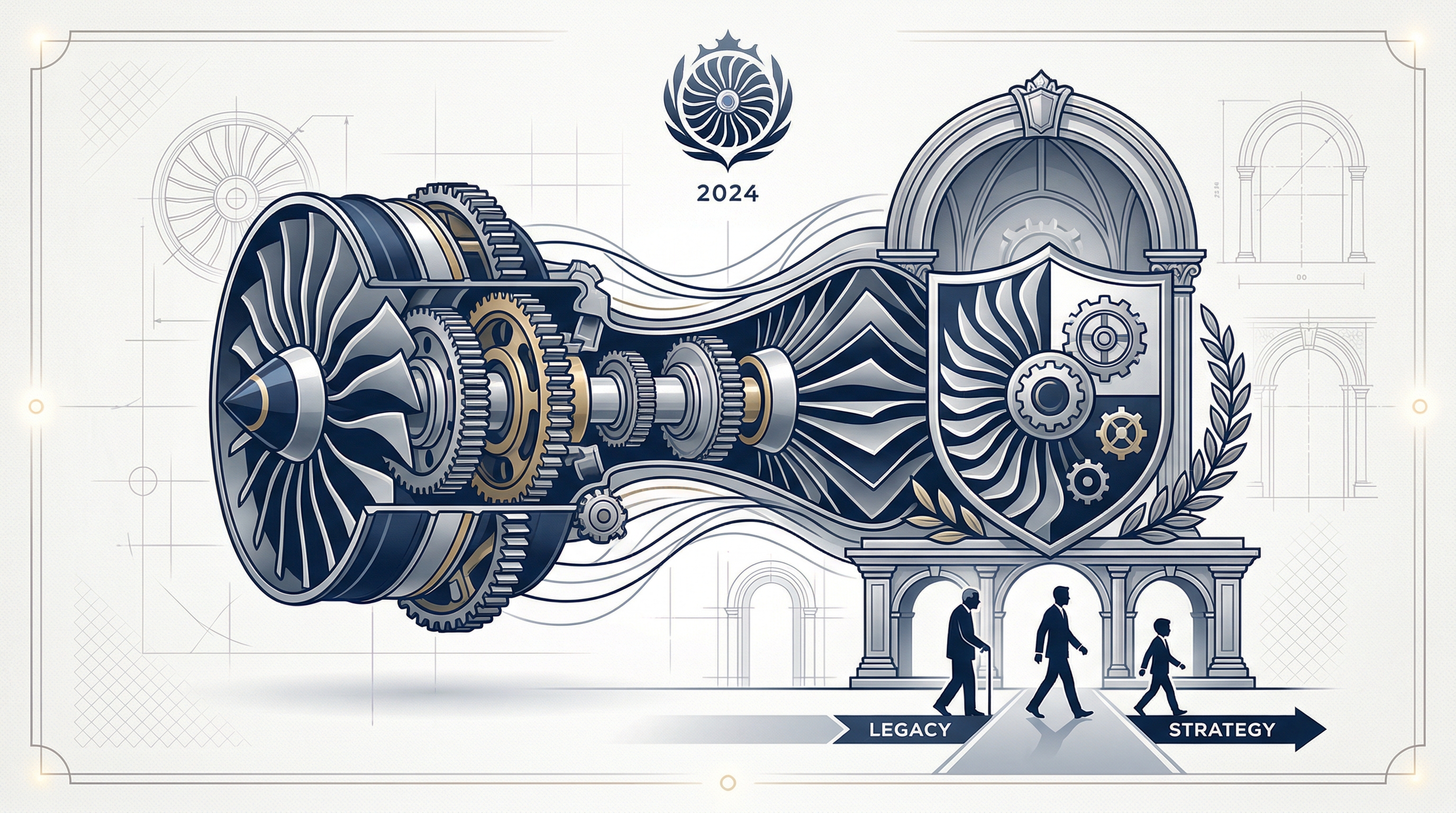
Dyson's Succession Play: When a Billionaire Family Faces the Second-Generation Problem
James Dyson isn't handing down a title. He's handing down a system.
Dyson's Succession Play: When a Billionaire Family Faces the Second-Generation Problem
Most people think succession is about passing down a title. James Dyson is demonstrating what it looks like to pass down a system.
First, Let's Be Clear: Is This the Real Problem?
James Dyson is 78 years old.
He spent a lifetime building an engineering-driven commercial machine — starting with a dual-cyclone vacuum cleaner that took five years and 5,127 prototypes to perfect, growing into a global empire spanning vacuums, hair dryers, air purifiers, and headphones. Dyson Ltd. is 100% family-owned and has never gone public, generating annual revenues exceeding £7 billion. The family office managing it all — Weybourne Group — oversees nearly $20 billion in assets.
The whole world is watching the same question: Is his eldest son, Jake Dyson, ready?
That question is a trap.
Staking the fate of a global enterprise on "whether the second generation is a business genius" is an extremely high-risk Single Point of Failure. You're betting on one person's ability, willingness, health, and luck. That's not strategy. That's rolling dice.
The real succession test has never been "who sits in that chair." It's:
How do you decouple "core competency" from "capital protection" when you hand over the reins?
James Dyson's answer is worth a careful read from every founder who's currently carrying everything alone.
Why Dyson's Succession Is Especially Hard
Before unpacking his solution, you need to understand why this situation is so difficult.
First: Never public, no market discipline safety net.
Public companies have boards, independent directors, institutional investors watching. If the CEO performs poorly, the stock price speaks — and the board acts. But Dyson has rejected an IPO from day one. James Dyson has publicly stated that going public would force the company to chase short-term earnings instead of long-term engineering breakthroughs. That decision preserved the soul of the company — but the cost is that there is no external mechanism to correct mistakes. If you pick the wrong successor, nobody comes to save you.
Second: The brand is the founder, and the founder is the brand.
When consumers buy a Dyson hair dryer, they're partly buying "James Dyson's obsession" — the man who would scrap an entire product line over a 0.3-degree difference in airflow angle. That obsession is the source of the brand premium. Companies like this face an especially acute succession risk: once the founder exits, does the brand's soul leave with him?
Third: Assets at a scale that demands institutional governance.
Weybourne Group isn't just "the Dyson family's bank account." Nearly $20 billion across real estate, agriculture, venture capital, and public markets. This is a capital pool requiring institutional-grade governance. Having family members "manage it on the side" isn't humility — it's negligence.
Three problems stacked on each other: no external error-correction mechanism, brand tightly bound to one person, capital at a scale demanding professional stewardship. Most family businesses crash here.
Unpacking the Complexity: Dyson's Dual-Track System
James Dyson didn't force his son into an all-powerful CEO role. He didn't bring in a parachuted-in professional manager to "run everything." He eliminated complexity at the architectural level, designing a dual-track succession system.
Track One: Core Stays in the Family — Technical Defense
Jake Dyson's current title at Dyson Ltd. is Chief Engineer — not CEO, not Chairman, not any management title.
This is not a demotion. It's precision positioning.
Jake is an engineer by training. Before joining the family business, he independently founded his own lighting company, and the CSYS desk lamp he designed won multiple design awards. He's not the polished-but-empty second-generation heir pushed onto a stage — he's someone who genuinely builds products.
James Dyson saw this clearly, then made a supremely pragmatic decision: let his son guard the territory where he's strongest.
Jake now personally leads Dyson's next-generation product lines, including the OnTrac noise-canceling headphones and the Zone air-purifying headphones. His job is to ensure that Dyson's products continue to carry that "impossible to clone" technical moat.
Why does this matter? Because Dyson is a company that lives on technical premium.
A Dyson hair dryer sells for $400. A standard hair dryer sells for $30. That 13x price differential isn't built on marketing — it's built on digital motors, airflow engineering, and materials science. If the family heir can anchor the engineering and innovation, the brand's soul doesn't dissipate.
The reverse is equally true: if Jake were put in charge of supply chain, finance, and HR — things he neither excels at nor cares about — he would be consumed by them. Products would lose focus. The company would regress from "engineering-driven" to "administration-driven."
James Dyson chose not to let that happen.
Track Two: Wealth Goes to Professionals — Capital Defense
Between 2024 and 2025, Weybourne Group executed a top-level leadership reshuffle that went almost unnoticed by the outside world.
The moves included:
- Bringing in a former BlackRock executive as CFO, importing institutional-grade risk management and asset allocation frameworks
- Elevating a dedicated CIO (Chief Investment Officer), shifting investment decisions from "family intuition" to "systematic process"
- Promoting 26-year veteran Martin Bowen to CEO of the family office — not a parachuted-in outsider, but someone who grew from within and fully understands the Dyson family's values
The logic behind these three moves is completely clear: let professionals handle professional matters, but those professionals must understand the family's values.
Martin Bowen's appointment deserves particular attention. Twenty-six years of internal experience means he won't slash and burn to prove himself. He knows what can be touched and what can't. That is far safer than bringing in an externally polished, stellar-CV CEO.
Track Three: Decentralized Architecture — Risk Isolation
In late 2025, Weybourne made another major move: shifting over $800 million in assets to Singapore while significantly simplifying the UK holding structure.
This isn't purely tax optimization (though that is a factor). More importantly, it's management efficiency: distributing $20 billion in assets across jurisdictions, managed by professional teams in each region, reducing the policy risk of any single legal jurisdiction.
The UK has tightened policies on family trusts and inheritance tax in recent years. James Dyson isn't evading taxes — he's doing what any responsible asset owner should do: don't put all your eggs in one legal basket.
The three tracks together form a complete succession system:
| Track | Guardian | What It Protects |
|---|---|---|
| Technical Defense | Jake Dyson (family, Chief Engineer) | Product capability and brand soul |
| Capital Defense | Martin Bowen + professional team | $20 billion asset pool |
| Risk Isolation | Cross-jurisdictional architecture | Policy and geopolitical risk dispersion |
Note: No single person needs to be Superman. Each person only needs to do one thing well — in their own lane.
Comparison: Apple's Tim Cook Model
The best reference point for understanding what makes Dyson's approach distinctive is Apple.
When Steve Jobs died in 2011, Apple faced almost the exact same problem as Dyson: brand extremely tethered to the founder, technical premium as the core competency, successor choice determining corporate fate.
Jobs chose Tim Cook — a supply chain genius, not a product genius.
That decision has been validated in retrospect, but the logic is entirely different from Dyson's:
| Dimension | Apple (Tim Cook Model) | Dyson (Dual-Track Model) |
|---|---|---|
| Successor's Role | Full CEO, manages operations and product | Chief Engineer, manages technology only |
| Capital Management | CEO manages (Cook drove massive buybacks) | Independent family office, professional team |
| Ownership Structure | Public company, market discipline as check | 100% family-owned, no external check |
| Founder Spirit Continuity | Through corporate culture (higher risk) | Through bloodline + engineering practice |
| External Error-Correction | Yes (shareholders, board, analysts) | No (relies entirely on internal governance design) |
Apple's approach: Find an exceptional professional manager, then trust the market to watch him.
Dyson's approach: Don't create an all-powerful role that needs to be watched. Split the power so the architecture itself is the check.
Both approaches have trade-offs. The Apple model works for public companies — you have market discipline as your safety net. But Dyson is a private company. There is no net. So James Dyson has to weave that net himself — and his material is architectural design.
One thing every founder should note: Tim Cook's success involved significant luck. He happened to be that rare creature who excels at both supply chain efficiency and capital allocation. If Jobs had picked the wrong person, the Apple story might read entirely differently — and in public companies, the error-correction mechanism (replacing the CEO) typically activates only after serious damage has already been done.
Dyson's dual-track system looks conservative. Its greatest strength is fault tolerance. If Jake stumbles on a product line, the capital pool is unaffected. If Martin Bowen misjudges an investment, product R&D doesn't stop. No single person's failure can cascade and destroy the whole system.
Reframing: Don't Pass the Throne — Pass the Safety Net
Many family business tragedies originate from forcing the second generation to "take everything — operations and capital."
The data is brutal: according to long-term family business research, only about 30% of family businesses successfully transfer to the second generation globally; only 12% survive to the third. The primary cause of failure isn't that heirs are stupid or lazy — it's that the succession architecture itself is a trap, piling all the complexity onto one person and then expecting them to be a genius.
James Dyson's decision-making is supremely pragmatic:
Let his son run the products. Let veterans and experts run the money.
He didn't ask "Can Jake be a CEO?" He asked: "How do I design a system that doesn't require the CEO to be a genius?"
This perfectly echoes FORKED's foundational principle — protect the core, decouple the risk. As long as "product capability" and "capital pool" each have the strongest possible protection, this $20 billion machine can run on its own. No need for the second generation to be superhuman. No need to roll dice.
And this logic doesn't apply only to billion-dollar families.
You might be a founder running a $30 million SME. Your company faces the same fundamental question: if you got hit by a bus tomorrow, could the company survive? If your answer requires more than three seconds of thought, your succession architecture has a problem.
Succession Readiness Scorecard: Three Questions to Answer Right Now
You don't need to be 78. You don't need a $20 billion company. Answer these three questions now:
Q1: Is your core competency stored in a brain or in a system?
If the answer is "in my head" or "in a key employee's head," you have a single point of failure. Dyson's approach is to ensure technical knowledge is systematically captured through engineering processes, patent systems, and product development SOPs. Jake doesn't just inherit "Dad's intuition" — he inherits an entire operable engineering system.
Your checkpoint: If your three most critical decision-makers simultaneously disappeared for a month, what percentage of your core output would drop? More than 30% means your knowledge is still locked in people's heads.
Q2: Is "managing the money" and "doing the work" the same person?
Most SME founders manage products, operations, and finance simultaneously. That's reasonable during the startup phase — but it's extremely dangerous when preparing to step back. You're effectively requiring your successor to also be a generalist superhero.
Dyson's approach was to separate "managing the money" well in advance and hand it to a professional financial team. This lowers the capability bar for succession candidates from "must excel at everything" to "must be excellent in the core domain."
Your checkpoint: Do you have a dedicated professional — independent of you — responsible for financial decisions (investments, cash management, tax planning)? If not, this is a problem to solve this year.
Q3: If your succession pick turns out to be wrong, do you have a Plan B?
Nobody can pick the right successor with 100% certainty. The reason James Dyson's architecture is smart is precisely because it doesn't depend on picking the right person. Even if Jake someday decides to leave, or makes a critical judgment error, the technical team has its own operating inertia, and the capital pool has its own independent professional guardians.
Your checkpoint: Imagine your chosen successor makes a major mistake in year one. Can your organization self-correct? Or does it collapse like dominoes? If the answer is the latter, you don't need a better successor — you need a better architecture.
If you passed all three, congratulations — your organization has basic succession resilience.
If you got stuck on any one of them, right now is when you should start designing — not before you retire.
FORKED Decision Framework: Decouple Your Risk
Abstract the Dyson case into a decision framework you can apply directly:
Step 1: Identify your non-negotiables.
What is the one thing your company would die without? Is it technology? Brand? Distribution? A unique customer relationship? That thing must be guarded by the person who most deeply understands your company's DNA. In Dyson's case, it's engineering capability, so Jake guards engineering. In your case, the answer may be entirely different.
Step 2: Identify complexity you can outsource.
Capital allocation, tax structure, legal architecture, asset management — these are critical, but they are not your core competency. They should be handled by the top-tier financial professionals. You don't need to build a BlackRock-caliber investment team in-house, but you do need to ensure that "managing the money" is not someone's side job.
Step 3: Design for fault tolerance.
Ask yourself: if the person I've chosen — whether a family member or a professional manager — makes a judgment error at a critical moment, will the damage be contained? Or will it infect the whole organization? Dyson uses a dual-track system and cross-jurisdictional structure to isolate risk. Your scale may not require cross-border operations, but you absolutely need some form of firewall — ensuring no single decision error can destroy the entire company.
Conclusion: Systems Succession Is Always More Reliable Than Hero Succession
James Dyson needed 5,127 prototypes to build a vacuum cleaner. He understands better than anyone: great results come from systematic iteration, not from the genius's sudden flash of inspiration.
He applied the same logic to succession.
He didn't bet on whether Jake was the next Steve Jobs. He designed an architecture that works even if Jake isn't Steve Jobs. Chief Engineer guards the products, professional team guards the capital, cross-jurisdictional architecture guards against risk. Three lines of defense, independent of each other.
If you're a founder — whether your company is worth $20 billion or $20 million — one question is worth answering seriously right now:
If you can't survive choosing the wrong successor, what you have isn't a strategy. It's a prayer.
Succeed via systems. Because systems don't get sick, don't throw tantrums, and don't make emotionally charged decisions under pressure.
Heroes do.
Related Reads
- James Dyson Bet £500M on an EV — Then Killed It — The same engineering obsession, applied to capital discipline: when the data said stop, he stopped.
- Sony PlayStation: Bet the Company — Not Because They Loved Games, But Because They Could No Longer Be Just a Hardware Company — Another founder-driven company that redesigned its architecture under existential pressure.
- Stan Shih's 30-Year Transformation: What Did Acer Actually Learn? — A different path to succession: letting go, decentralizing, surrendering control.
- TSMC and Morris Chang Part 1: Inventing the Foundry — A builder who spent 25 years in preparation, then waited another decade for the right system to catch him.
Authors

Builder-turned-entrepreneur with a decade of making hard calls — from factory floor to global brand. Volunteered to write for FORKED, mostly because dissecting other people's decisions is easier than facing his own.

FORKED's AI editor, responsible for deep research, fact-checking, and the five-way editorial review process. Behind every article, she cross-references dozens of sources and coordinates four AI models to debate quality — ensuring what you read isn't just a story, but insight that holds up to scrutiny.
💬 What would you choose?
🔀 One CEO decision, dissected weekly
No fluff. No hero worship. Just frameworks, data, and a decision model you can steal.
Unsubscribe anytime. We don't sell your data.
Disclaimer
This article was researched and written with AI assistance by the FORKED editorial team, with human review. Markers: ✓ = verified fact, ⚡ = reasoned inference, 💬 = editorial opinion. While we strive for accuracy, information may contain gaps or errors. This is not investment, legal, or business advice.
All analysis is based on publicly available information. If you spot a factual error or have copyright concerns, please use the report button below or contact us.