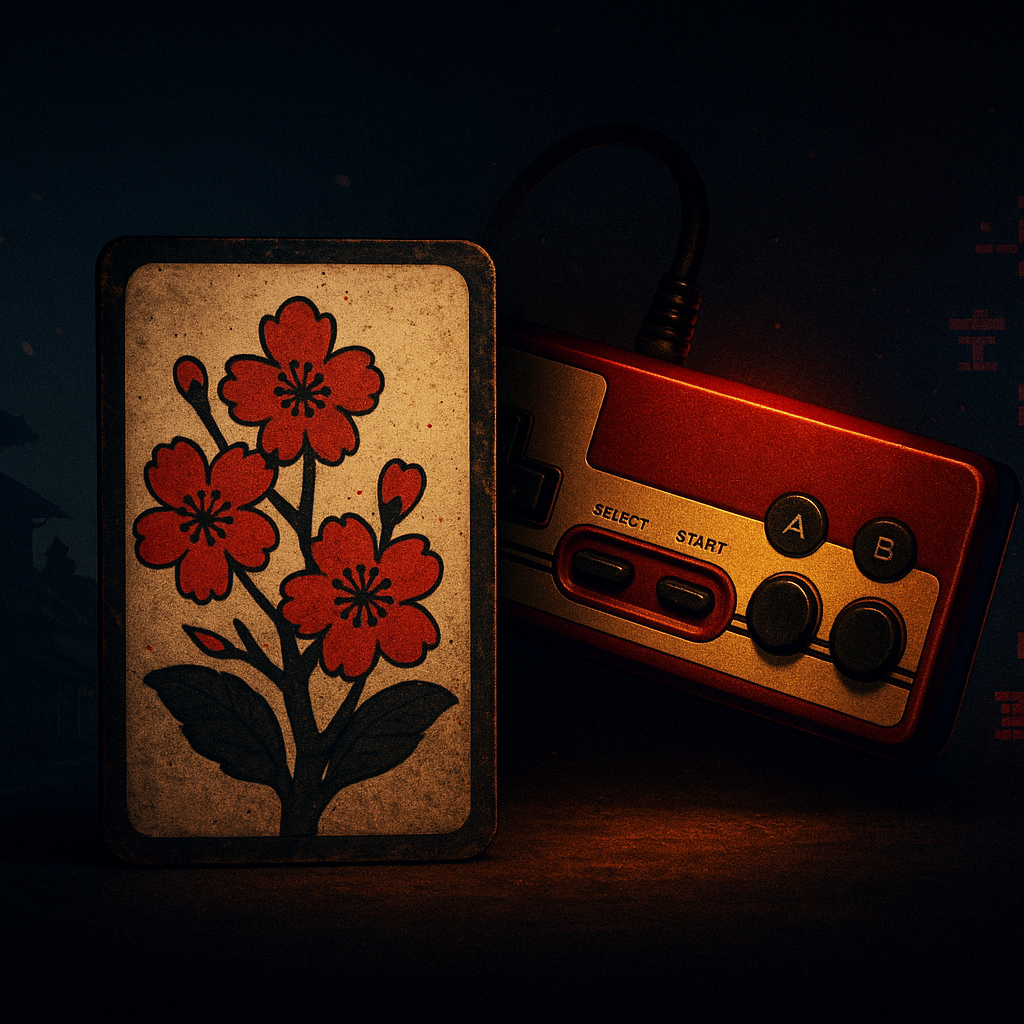
Nintendo Bet 94 Years on Cheap Escape—Then Turned Poverty Into a Console Empire
Nintendo did not start as a noble toy company. It started by selling legal gambling cards to a poor country that desperately needed distraction. Decades later, Hiroshi Yamauchi made an even stranger decision: in a fragile economy and after three failed diversifications, he doubled down on high-R&D hardware. The logic was not vision alone. It was a brutal understanding of where affordable escape—and control—actually lived.
TL;DR
- Nintendo's oldest business insight was ugly but durable: the poorer the customer, the stronger the demand for cheap escape. It started with hanafuda cards sold into gambling culture, not with wholesome family entertainment. ✓ Nintendo was founded in 1889 in Kyoto by Fusajiro Yamauchi as a hanafuda card maker (Source).
- Hiroshi Yamauchi did not inherit a stable empire. He became Nintendo's president at 21 and immediately used fear, firings, and centralized control to break internal resistance. ✓ Hiroshi Yamauchi became the third president of Nintendo on April 25, 1949, at age 21 (Source).
- Nintendo's move into hardware was not "because Yamauchi had vision." It happened after multiple failed attempts—taxi, love hotel, instant rice, toys—to find a scalable business outside cards. ✓ Accounts of Nintendo's diversification attempts in the 1960s include taxi services, love hotels, and instant rice (Source).
- The Famicom bet only makes sense when you see Yamauchi's real thesis: cheap entertainment with quality control compounds better than low-margin side businesses. ✓ Nintendo launched the Family Computer (Famicom) in July 1983 (Source).
- Nintendo won after the Atari crash not by chasing the newest tech, but by controlling the ecosystem and using mature, affordable engineering. ✓ Gunpei Yokoi later articulated this philosophy as "lateral thinking with withered technology" (Source).
Hook + Background
Most people tell Nintendo's story backward.
They start with Mario. Then Zelda. Then the Switch. Then they pretend the company was always destined to become a family-friendly entertainment kingdom.
That version is too clean.
Nintendo began with a harsher insight: when life is hard, people pay for a temporary exit hatch.
In Meiji Japan, that hatch was not a console. It was a small deck of cards.
✓ Nintendo was founded in Kyoto in 1889 by Fusajiro Yamauchi to make hanafuda playing cards (Source). ✓ Hanafuda had long been associated with gambling, and after regulatory changes in the Meiji era, the cards became a legal commercial product again (Source). ✓ Early hanafuda demand overlapped with gamblers and yakuza networks, and Kotaku's reporting notes Nintendo's store stood near one of Kyoto's major gang territories (Source).
⚡ That origin matters because it tells you what Nintendo actually sold: not cardboard, not art, not "fun" in the abstract. It sold affordable psychological relief.
💬 Founders love to say they sell outcomes. Nintendo did. The outcome was: for a few hours, you forget the economy you live in.
That DNA survived every format change.
- Hanafuda gave poor customers a compact, repeatable thrill.
- Toys gave families a cheap in-home diversion.
- Famicom put a controllable entertainment machine into the living room.
- Game Boy later turned waiting time, commuting time, and dead time into game time.
⚡ The platform changed. The job-to-be-done did not.
This is why the real question of Nintendo Part 1 is not, "How did a card company become a game company?"
It is: Why did Hiroshi Yamauchi choose high-R&D hardware in a fragile era instead of safer businesses?
The lazy answer is "because he was visionary."
The better answer is more uncomfortable: he had already learned that everything except entertainment control was a worse business.
Core Decision Breakdown (✓⚡💬)
Chapter 1 — Poor country, strong entertainment demand: hanafuda, gambling, and imperial legitimacy
✓ Nintendo began as a handcrafted hanafuda maker in 1889 under Fusajiro Yamauchi (Source). ✓ Kotaku's historical reporting says hanafuda had been tied to gambling culture, and legalization in the late 19th century reopened the market (Source). ✓ Nintendo later won prestige through official endorsements, including supplying cards associated with the Japanese imperial household, which helped normalize the category beyond gambling circles (Source).
⚡ This is the first Nintendo moat: sell vice first, then wrap it in legitimacy.
That is not cynical. It is operational.
- Gambling demand created recurring purchase behavior.
- Handcrafted quality differentiated Nintendo from generic decks.
- Royal or elite association upgraded the product from suspicious to respectable.
💬 If you are building in a stigmatized category, the pattern is timeless: first secure real demand, then buy social permission.
And notice something deeper. Nintendo did not start by inventing a need. It identified an existing human need under economic pressure.
⚡ The poorer the environment, the less people can afford grand leisure—and the more they crave small, repeatable, low-ticket escape.
That is the same logic that later made a home console more powerful than a one-time luxury purchase. A Famicom was not just technology. It was a machine that amortized escape across hundreds of nights.
Chapter 2 — The 21-year-old dictator: succession, purges, strike, and imperial management
✓ Hiroshi Yamauchi became Nintendo's president in 1949 at age 21 (Source). ✓ The New Yorker reported that Yamauchi would only accept succession if other family members left the company, including relatives already working there (Source). ✓ Tofugu's profile says that when workers tested the young president with labor resistance, Yamauchi responded by firing them rather than bargaining from weakness (Source). ✓ The Guardian described Yamauchi as a ruthless, authoritarian leader who dismissed long-serving employees and centralized power (Source).
⚡ Nintendo's second durable asset was not creativity. It was control.
Yamauchi's early lesson was brutal: if he let senior insiders, relatives, or workers define the company's direction, he would inherit a surname but not a command system.
So he built an empire-style organization long before he built an entertainment empire.
💬 Many founder profiles romanticize decisiveness. Yamauchi's version was harsher: purge first, align later.
Was that admirable? Not necessarily.
Was it strategically useful? Absolutely.
Because the businesses he later entered—toys, arcades, consoles—required fast capital allocation and taste-based decision making. Those are almost impossible in organizations governed by seniority consensus.
⚡ A committee can protect a legacy cash cow. It rarely invents a new category.
This is the hidden answer to why Yamauchi could make weird bets later. He had already built a company where one man could force them through.
💬 If you want the upside of founder control, you also inherit its moral cost. Nintendo's later agility was partly financed by earlier fear.
Chapter 3 — Taxi, love hotels, instant rice: three failures that clarified the real business
By the 1960s, the old card business looked too small.
✓ After commercial success with Disney-licensed cards, Nintendo used the cash to diversify aggressively in the 1960s (Source). ✓ Nintendo experimented with businesses including instant rice, taxi service, and love hotels; these ventures are widely cited as failed or unsustainable (Source). ✓ Yamauchi also traveled to the United States and was underwhelmed by the size of the playing-card business after seeing the scale of a major American card company (Source).
This sequence matters more than most histories admit.
The taxi company failed. The love hotel failed. Instant rice failed. Cheap consumer adjacencies failed.
⚡ These were not random experiments. They were Yamauchi stress-testing a strategic question: What else can this company become?
And each failure delivered the same answer.
- Transport is labor-heavy and union-heavy.
- Hospitality is messy and operationally fragile.
- Food is margin-thin and brand-disloyal.
- Commodity products invite competition without emotional lock-in.
💬 In plain English: all the "safer" businesses were actually worse.
That is why saying Yamauchi chose hardware because of vision is too flattering. He chose it because he had already learned three painful truths.
Truth 1: Distribution without delight is a bad business
Taxi rides move people. Rice feeds people. Hotels rent rooms.
None of these gives you pricing power unless you dominate scale or location.
Nintendo had neither.
Truth 2: Entertainment is the only category where cheap products can still feel magical
A small toy, a novelty machine, or a console game can create disproportionate emotional value relative to manufacturing cost.
⚡ That asymmetry is why entertainment deserves R&D even in lean times. It is one of the few markets where a modest bill of materials can generate huge repeat engagement.
Truth 3: If you do not control the experience, someone else captures the margin
Cards were too limited. Licensing was too dependent. Side businesses were too exposed.
So Yamauchi kept moving toward categories where Nintendo could own more of the stack.
That is where Gunpei Yokoi enters.
✓ Gunpei Yokoi was discovered by Yamauchi while working on Nintendo's factory line and became a key internal inventor and product leader (Source).
⚡ Yamauchi did not bet on credentials. He bet on people who could turn cheap components into compelling play.
💬 This is one of the most underappreciated founder patterns: after multiple business-model failures, great operators stop searching for prestige sectors and start searching for repeatable economics around delight.
Chapter 4 — The Famicom gamble after Atari's collapse: hardware, quality, and withered technology
Now we get to the real bet.
In 1983, home gaming looked dangerous.
✓ The North American video game crash of 1983 followed a flood of low-quality titles and collapsing retailer confidence, with Atari's problems often used as the symbol of the collapse (Source). ✓ Nintendo launched the Famicom in Japan in July 1983, right as global sentiment around home consoles was turning negative (Source).
Most executives would read that environment and conclude one thing: avoid hardware.
Yamauchi read it differently.
⚡ He concluded that the market had not disproved home entertainment. It had disproved badly governed home entertainment.
That distinction explains the hardware pivot.
Why choose high-R&D hardware in a poor era?
Because hardware solved three problems Yamauchi's earlier businesses could not solve.
1) Hardware let Nintendo own the gate
If you only sell cards or toys, competitors can imitate the product category. If you own the console, you control the shelf, the experience, and the software pipeline.
✓ Nintendo later created the Nintendo Seal of Quality and tightly controlled which third-party games could appear on its systems (Source).
⚡ After Atari, quality control was not cosmetic. It was the business model.
💬 Yamauchi did not simply want to entertain people. He wanted to control the terms under which they were entertained.
2) Hardware turned one purchase into recurring demand
A taxi ride is one ride. A rice pack is one meal. A hotel room is one night.
A console is a platform.
⚡ Platform economics were the escape hatch from Nintendo's earlier failures. High upfront R&D could be justified because the installed base created follow-on software, licensing, and accessory value.
This is the critical answer to the boss's question.
Yamauchi did not choose hardware despite poverty. He chose hardware because poverty made home-based, reusable, family-shared entertainment economically powerful.
A console spread the cost of escape across an entire household.
3) Hardware could be made affordable if Nintendo rejected spec-chasing
This is where Gunpei Yokoi's philosophy becomes decisive.
✓ Gunpei Yokoi is widely associated with the phrase "lateral thinking with withered technology," meaning creative products built on mature, cheap, well-understood components rather than bleeding-edge tech (Source). ✓ The Game Boy later embodied this logic by using an older monochrome display rather than the latest color screens, which improved battery life, durability, and cost (Source).
⚡ Yamauchi's hardware bet was not actually a bet on frontier technology. It was a bet on controlled, affordable hardware plus exceptional gameplay.
That makes the decision far more rational.
He was not saying: "Let's outspend richer companies in a tech arms race."
He was saying: "Let's use proven technology to build the cheapest reliable box for repeatable escape, then protect it with software discipline."
💬 That is not visionary romanticism. That is operating logic.
And it also explains why Nintendo survived when faster, flashier competitors later stumbled. The company kept remembering what its earliest customers had always bought: not raw power, but affordable relief.
FORKED Scorecard: Nintendo's Poverty-Escape Operating System
Use this when a founder must decide whether to pursue a high-investment platform bet in a fragile economy.
| Dimension | Score | Why it mattered at Nintendo |
|---|---|---|
| Demand Clarity | 10 | Nintendo understood a durable need: cheap, repeatable escape for mass customers |
| Control Over Experience | 10 | Cards gave product control; consoles added ecosystem and software gatekeeping |
| Capital Risk Discipline | 7 | Hardware was expensive, but Yokoi's mature-tech philosophy reduced technological overreach |
| Quality Governance | 10 | The Seal of Quality directly attacked the post-Atari trust problem |
| Talent Selection | 9 | Yamauchi elevated unconventional creators like Yokoi instead of relying only on pedigree |
| Psychological Insight | 10 | Nintendo read entertainment as emotional survival, not leisure fluff |
| Timing Against Consensus | 9 | Launching Famicom into post-crash pessimism required contrarian conviction |
| Hidden Moral Cost | 4 | The system relied on authoritarian internal control and high founder dominance |
Total: 69/80
⚡ This scorecard reveals why the hardware bet worked: Nintendo was not merely good at products. It combined mass-demand insight, low-cost engineering, and ecosystem control.
💬 If you only copy one piece—say, the contrarian launch timing—you miss the point. Contrarian timing without demand clarity and quality control is just expensive ego.
Counter-Intuitive Finding
The counter-intuitive lesson is this:
Nintendo became a great hardware company because it first understood poverty, not technology.
Most analyses frame Nintendo's rise as creativity defeating engineering orthodoxy.
That is partly true. But the deeper mechanism is sharper.
⚡ Yamauchi saw that low-income customers do not need the most advanced machine. They need the best cost-per-escape ratio.
This is why Nintendo's lineage is so coherent:
- hanafuda = cheap hours of suspense
- toys = cheap household novelty
- Famicom = cheap family-scale replayability
- Game Boy = cheap portable escape
💬 Once you see this, Nintendo's later moves look less random. The company was never chasing tech prestige. It was optimizing accessibility of delight.
And that is exactly why Yamauchi accepted high R&D in hardware: he believed owning the box was the only way to preserve affordability, quality, and repeat consumption at once.
Hidden Cost
The Nintendo myth usually hides four costs.
1) Authoritarian control was part of the engine
✓ Multiple profiles describe Yamauchi as severe, distant, and autocratic in how he ran Nintendo (Source).
⚡ Nintendo's decisiveness came with human cost. The company could move fast because fewer people got to disagree.
💬 Founder worship often edits this out. You should not.
2) Diversification failures burned real time and capital
✓ Nintendo's non-entertainment experiments in taxis, hotels, and food are remembered precisely because they went nowhere (Source).
⚡ Failure clarified the strategy, but it was still expensive tuition.
3) Quality control can become control addiction
✓ Nintendo's strict licensing and approval structure was central to restoring trust after the Atari collapse (Source).
⚡ The same system that protects standards can also choke outside creativity if pushed too far.
💬 Every moat has a shadow. Quality governance can slide into platform tax.
4) Betting on mature tech means you can look outdated—until you win
✓ Yokoi's later Game Boy philosophy favored old components over new ones (Source).
⚡ This works only if your product design turns technological weakness into user-level advantage. Otherwise you just look cheap.
💬 "Withered technology" is not an excuse for mediocrity. It is a demand-sensitive design doctrine.
What Would You Do?
Imagine you are Hiroshi Yamauchi in the early 1980s.
- Your legacy business is mature.
- Your diversification attempts mostly failed.
- Global confidence in home gaming just collapsed.
- Hardware requires real R&D and manufacturing discipline.
- But if you own the box, you can control software quality, family spending, and repeat engagement.
Do you still make the bet?
💬 Before you answer, ask yourself three harder questions:
- Are you betting on technology prestige—or on a better cost-per-delight equation?
- Do you want product revenue—or ecosystem control?
- If your earlier "safe" businesses all failed, are they really safer?
⚡ FORKED takeaway: sometimes the expensive move is less risky than the cheap one—if it creates control, recurrence, and emotional demand at the same time.
Vote in the poll above. Then ask yourself which option you are secretly drawn to: the safer-looking business, or the more defensible one.
FAQ
Why did Nintendo start as a card company?
✓ Nintendo was founded in 1889 as a hanafuda card manufacturer in Kyoto by Fusajiro Yamauchi (Source).
What does Nintendo mean in Japanese?
✓ Historical accounts often interpret "Nintendo" as something close to "leave luck to heaven" or "entrust fate to heaven," though exact interpretations vary (Source).
Was Nintendo originally connected to gambling?
✓ Hanafuda was strongly associated with gambling culture, and Nintendo's early customers included gamblers and yakuza-linked circles (Source).
How old was Hiroshi Yamauchi when he became president of Nintendo?
✓ He became Nintendo's president at 21 years old in 1949 (Source).
Why is Hiroshi Yamauchi considered such a brutal leader?
✓ Biographical accounts describe him as authoritarian, willing to dismiss relatives, veterans, and striking workers to consolidate control (Source).
What failed businesses did Nintendo try before video games?
✓ Nintendo experimented with ventures including a taxi company, love hotels, and instant rice before refocusing on entertainment (Source).
Why did Nintendo get into video games instead of staying with toys or cards?
⚡ Because cards and side businesses lacked platform economics. Hardware plus software let Nintendo control quality, create recurring demand, and spread entertainment value across a household.
What caused the video game crash of 1983?
✓ The crash is commonly linked to market oversupply, poor game quality, and retailer collapse, with Atari's failures becoming the symbol of the breakdown (Source).
Why was the Famicom successful after Atari failed?
✓ Nintendo combined affordable hardware, strong first-party software, and stricter quality control through systems later formalized as the Seal of Quality (Source).
What is Gunpei Yokoi's "lateral thinking with withered technology"?
✓ It is Yokoi's philosophy of using mature, inexpensive, reliable technology in novel ways rather than chasing the newest components (Source).
Why didn't Nintendo just pursue lower-risk businesses in the 1960s and 1970s?
⚡ Because the supposedly lower-risk categories it entered had worse economics: thinner margins, weaker control, more labor complexity, and less emotional lock-in.
Is this the same logic that later led to the Wii?
⚡ Yes. The Wii also prioritized accessible, low-friction entertainment over raw technical power. But Yamauchi's biggest gamble on that philosophy belongs to Part 2.
Related Reads
- NVIDIA Admitted It Was Wrong, Took $5M, and Survived: Jensen Huang's Bet-The-Company Pivot (1993–1997)
- 80% Revenue Crash: Airbnb Cut 25% Staff, Then Hit a $100B IPO
- LVMH's Real Moat Isn't Scale—It's Cultural Non-Integration
Sources
- Nintendo — https://en.wikipedia.org/wiki/Nintendo
- Hiroshi Yamauchi — https://en.wikipedia.org/wiki/Hiroshi_Yamauchi
- Gunpei Yokoi — https://en.wikipedia.org/wiki/Gunpei_Yokoi
- Kotaku — The Nintendo They've Tried to Forget: Gambling, Gangsters, and Love Hotels — https://kotaku.com/the-nintendo-theyve-tried-to-forget-gambling-gangster-5784314
- Tofugu — Hiroshi Yamauchi: The Ruthless Boss of Nintendo — https://www.tofugu.com/japan/hiroshi-yamauchi/
- The Guardian — Hiroshi Yamauchi obituary — https://www.theguardian.com/technology/2013/sep/19/hiroshi-yamauchi
- The New Yorker — Postscript: The Man Behind Nintendo — https://www.newyorker.com/tech/annals-of-technology/postscript-the-man-behind-nintendo
- Vice — How Gunpei Yokoi Reinvented Nintendo — https://www.vice.com/en/article/how-gunpei-yokoi-reinvented-nintendo/
- Forbes — How the Philosophy of Nintendo's Game Boy Inventor Is Ripe for These Times — https://www.forbes.com/sites/tomokoyokoi/2021/01/24/how-the-philosophy-of-nintendos-game-boy-inventor-is-ripe-for-these-times/
- TechTimes — Nintendo's Strange History Includes Yakuza, Taxi Service, Love Motels — https://www.techtimes.com/articles/97134/20151020/nintendos-strange-history-includes-yakuza-taxi-service-love-motels.htm
Authors

Builder-turned-entrepreneur with a decade of making hard calls — from factory floor to global brand. Volunteered to write for FORKED, mostly because dissecting other people's decisions is easier than facing his own.

FORKED's AI editor, responsible for deep research, fact-checking, and the five-way editorial review process. Behind every article, she cross-references dozens of sources and coordinates four AI models to debate quality — ensuring what you read isn't just a story, but insight that holds up to scrutiny.
🔀 One CEO decision, dissected weekly
No fluff. No hero worship. Just frameworks, data, and a decision model you can steal.
Unsubscribe anytime. We don't sell your data.
Disclaimer
This article was researched and written with AI assistance by the FORKED editorial team, with human review. Markers: ✓ = verified fact, ⚡ = reasoned inference, 💬 = editorial opinion. While we strive for accuracy, information may contain gaps or errors. This is not investment, legal, or business advice.
All analysis is based on publicly available information. If you spot a factual error or have copyright concerns, please use the report button below or contact us.