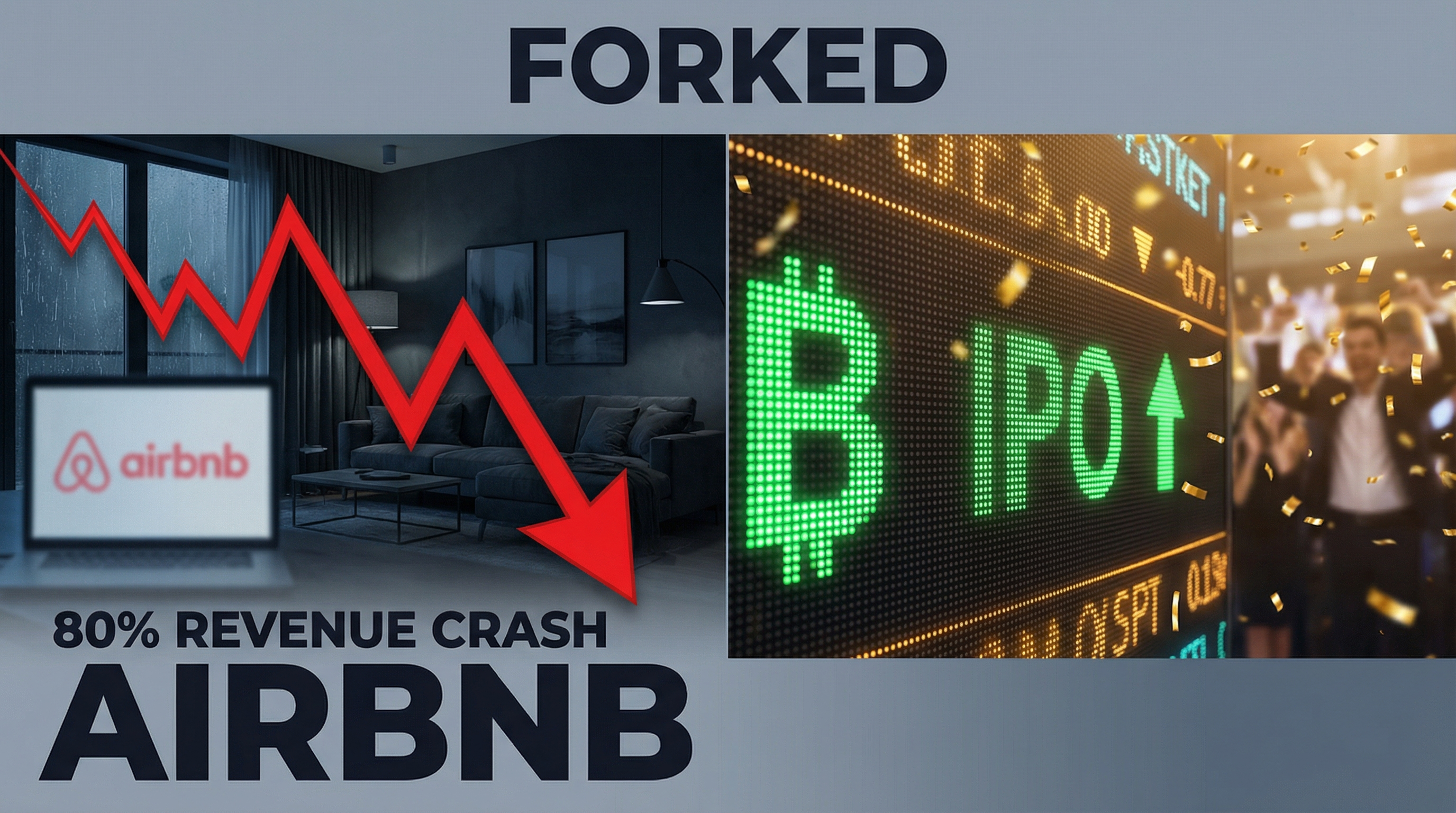
80% Revenue Crash: Airbnb Cut 25% Staff, Then Hit a $100B IPO
In eight weeks, Airbnb’s revenue fell 80%—a startup death spiral in slow motion. Brian Chesky responded by cutting deep, killing entire business lines, and borrowing $2B at a painful valuation. Nine months later, Airbnb priced its IPO at $68 and watched its market cap surge past $100B on day one.
Listen to this article
80% Revenue Crash: Airbnb Cut 25% Staff, Then Hit a $100B IPO
TL;DR
- ✓ Airbnb’s revenue dropped 80% in eight weeks when COVID hit (Source).
- ✓ Chesky cut ~1,900 people (~25%) and rewired the layoff package to preserve dignity and speed (Source).
- ✓ Airbnb raised $2B in capital in 2020—including a $1B Silver Lake/Sixth Street deal—at a much lower valuation (~$18B vs ~$31B pre-COVID) (Source).
- ⚡ The “pivot” wasn’t a reinvention. It was a violent return to the original marketplace after years of expansion.
- ✓ Nine months later, Airbnb priced its IPO at $68; on day one the stock more than doubled and the market cap crossed $100B (Source).
Hook
Imagine you’re running a marketplace that depends on strangers traveling.
Then a global pandemic arrives.
Within eight weeks, 80% of your revenue disappears—not “down 20%,” not “soft quarter,” but gravity turned off (Source).
Most CEOs would do one of two things:
-
Pretend it’s temporary and wait.
-
Panic-cut until the company is a husk.
Brian Chesky did something sharper: he treated COVID like a forced audit of Airbnb’s identity. Then he made decisions that were simultaneously brutal and unusually humane.
If you want the deeper operating philosophy behind his “founder mode” intensity, this story pairs well with: Brian Chesky’s Founder Mode: Why Airbnb’s CEO Rejected Autonomy.
Core Decision Breakdown (✓⚡💬)
1) He acknowledged the math early—and stopped pretending
- ✓ Airbnb saw the first shock in China: the business there dropped 80% in January 2020 (Source).
- ✓ After COVID spread, Airbnb’s revenue fell 80% in eight weeks (Source).
⚡ “Hope” is not a runway extension. When revenue collapses that fast, you’re not managing growth—you’re managing time.
💬 The first crisis decision is emotional: do you accept reality fast enough to act before you’re forced to?
2) He chose guests over hosts—then had to pay for the trust damage
- ✓ Airbnb overrode host cancellation policies to give guests full refunds, triggering host backlash (Source).
- ✓ Hosts argued they bore the cost, not Airbnb (Source).
- ✓ A class action lawsuit was filed by hosts related to the COVID refund policy (Source).
⚡ In a two-sided marketplace, “fair” is rarely symmetrical. In March 2020, Airbnb optimized for the demand side (guests) to preserve long-term marketplace credibility.
💬 If you run a platform: decide upfront who you’ll disappoint during shocks—then budget for the repair.
💬 Before you judge Chesky: think about the last time you had to choose whose pain to absorb. Your supplier, your employee, your early investor. In a two-sided marketplace—or any stakeholder ecosystem—someone always carries the loss during a shock. The question isn’t whether you protected everyone equally. It’s: did you have a plan for the repair?
3) He raised expensive capital—because bankruptcy is more expensive
- ✓ Silver Lake and Sixth Street invested $1B in debt and equity in April 2020 (Source).
- ✓ The deal implied a valuation around $18B, down from about $31B pre-COVID (Source).
- ✓ Airbnb raised $2B total capital in 2020 (Source).
⚡ Founders hate down rounds. But in a revenue cliff, valuation is a vanity metric; survival is the metric.
💬 If you’re negotiating in a crisis, don’t ask, “Is this fair?” Ask, “Does this buy the time we need at a cost we can actually repay?”
4) He cut deep—and made the layoff process a product
- ✓ On May 5, 2020, Chesky announced layoffs of ~1,900 employees (~25%) (Source).
- ✓ Severance: 14 weeks base + 1 week per year of tenure (Source).
- ✓ The company dropped the one-year equity cliff so departing employees became shareholders (Source).
- ✓ U.S. employees received 12 months of COBRA healthcare coverage (Source).
- ✓ Airbnb created an Alumni Talent Directory to help people find new jobs (Source).
⚡ A layoff is not just a cost action. It’s a trust event.
💬 The unfair truth: you can be “empathetic” and still destroy lives. But you can also be fast, clear, and generous—and reduce the blast radius.
5) He killed expansion bets and returned to the root marketplace
- ✓ Airbnb said it would forecast 2020 revenue at less than half of 2019 in the crisis update (Source).
⚡ When your future is fog, complexity becomes a tax. The winning move is often subtraction.
💬 If you can’t explain your core value in one sentence during a crisis, you don’t have a core—you have a portfolio of distractions.
6) He rode a weird rebound: local travel, driving distance, long stays
- ✓ Airbnb observed demand rebound as travelers shifted toward closer-to-home trips; CNBC reported the rebound began within months (Source).
⚡ Airbnb didn’t “predict” the pandemic. It recognized the new shape of travel faster than legacy hotels: dispersed, domestic, longer, less business-dependent.
💬 Don’t waste a crisis trying to resurrect the old demand curve. Find the new one.
7) He turned crisis narrative into public-market momentum
- ✓ Airbnb priced its IPO at $68/share at a $47.3B valuation (Source).
- ✓ On the first trading day, shares more than doubled; market cap surged past $100B (Source).
⚡ The market didn’t just buy revenue. It bought a story: “We survived the ultimate stress test.”
💬 If you ever plan to go public, your crisis response becomes your prospectus.
FORKED Scorecard: Chesky’s Crisis Response
Rate each dimension 1–10. The point isn’t the numbers—it’s what you’d copy and what you’d avoid.
-
Speed of Reality Acceptance (9/10)
- ⚡ Early signals (China down 80%) were treated as a real warning, not noise.
-
Runway Engineering (6/10)
-
Radical Focus (8/10)
- ⚡ Subtraction over reinvention: fewer bets, clearer core.
- 💬 Not a perfect 10: cutting is easier than rebuilding the trust you burn while cutting.
-
Stakeholder Fairness (4/10)
- ✓ The refund override protected guests but shifted the pain onto hosts—without symmetric compensation—triggering backlash and a class action lawsuit (Source).
- ⚡ In a marketplace, you can’t treat suppliers like a buffer forever; the payback is churn, distrust, and slower supply recovery.
- 💬 CEO self-check: When your company last faced a crisis, who absorbed the shock in your ecosystem—your suppliers, your early partners, your users? Did you compensate them, or did you just move on? Rate yourself honestly.
-
Human Cost Management (9/10)
- ✓ Layoff design prioritized severance, equity, healthcare, and placement support (Source).
-
Operational Clarity (8/10)
- ⚡ The open letter made the plan legible: what’s changing, why, and what happens next.
-
Rebound Readiness (7/10)
- ✓ Captured the shift to closer-to-home travel patterns (Source).
- ⚡ But the rebound mix mattered: domestic/drive-to demand doesn’t necessarily carry the same economics as global, high-value international travel.
Total: 51/80
💬 Steal this: In a crisis, you need three scorecards—cash, trust, and capitalization (terms + dilution). Most founders only track one.
Contrarian Finding
The dramatic comeback wasn’t driven by “travel coming back.” It was driven by travel getting smaller—and cheaper.
⚡ Airlines, resorts, and business travel got wrecked.
⚡ Weekend trips within driving distance surged.
Airbnb’s product was already shaped for that world. Chesky’s decision wasn’t to invent a new model—it was to stop distracting the company from the model that already fit the new demand.
But here’s the second-order twist: a rebound led by domestic, close-to-home travel can be a different business than a rebound led by international, high-intent travel. You survive—then you still have to re-earn the better mix.
Hidden Cost
Airbnb’s crisis playbook has a price tag most recap stories skip:
-
Host trust damage (real + lasting)
- ✓ Airbnb overrode host cancellation policies and issued refunds that many hosts felt were imposed without fair compensation—sparking backlash and a class action lawsuit (Source).
- ⚡ Second-order effect: even if demand returns, supply trust doesn’t snap back on command. Hosts remember who carried the loss when the world broke.
- 💬 In a marketplace, alienating suppliers (hosts) is like burning inventory—then paying higher “acquisition costs” to rebuild it.
-
Down-round stigma + expensive capital (and dilution)
- ✓ Valuation reportedly fell to around $18B in the 2020 financing (Source).
- ⚡ The $1B deal included warrants, meaning the “bridge” wasn’t just interest—it also pulled value forward via shareholder dilution.
- 💬 Translation: you may save the company, but you might also permanently reprice the ownership.
-
Rebound economics (mix matters)
- ✓ Demand returned first in closer-to-home travel patterns (Source).
- ⚡ Second-order effect: domestic/drive-to rebound can mean different ADRs, lengths of stay, and margin structure than international travel. “Recovery” can be real and economically thinner.
-
Public-market reality check
- ⚡ IPO day was euphoric—but public markets keep scoring you after the story. After peaking around $166/share, the stock later traded materially below that high.
- 💬 A crisis win can still be followed by years of valuation digestion.
-
Layoff trauma (even done “well”)
- ✓ 1,900 people still lost their jobs (Source).
- 💬 “Best layoff letter ever” is still a layoff.
What Would You Do?
You don’t get eight weeks of warning in most businesses. You get eight weeks of denial.
So here’s the dilemma:
💬 If 80% of your revenue vanished in eight weeks, would you cut deep immediately, raise expensive money, pause everything to refocus the core, or spend to protect your ecosystem?
⚡ Here is the version that haunts marketplace founders: On Day 14, your hosts—who built their livelihood on your platform—are furious. You overrode their contracts to protect guests. They are threatening to leave. You have three days before your emergency board call. What is your next move?
Cast your vote in the poll above—then go test your instincts in the crisis simulator.
Here’s the setup:
- You have 14 days before the next cash crunch meeting.
- Revenue just fell off a cliff.
- You’re burning hundreds of millions and every stakeholder wants a different “fair” outcome.
- You get 4 decisions (headcount, capital, marketplace trust, focus).
- No undo. Every choice trades runway against reputation.
👉 Enter the scenario: Play FORKED Stories
📩 Want more decision frameworks? Subscribe to the FORKED newsletter — one CEO decision breakdown per week, zero fluff.
FAQ
Did Airbnb almost go bankrupt during COVID?
✓ Airbnb’s revenue dropped 80% in eight weeks (Source). ⚡ A shock that steep can push even strong companies toward insolvency without rapid cost cuts and financing.
How did Airbnb survive COVID?
✓ Airbnb raised $2B in capital and cut ~25% of staff (Source). ⚡ The combination of runway + focus let it wait for demand to re-form.
How many employees did Airbnb lay off in 2020?
✓ About 1,900 employees—roughly 25% of its workforce at the time (Source).
What made Airbnb’s layoff response different?
✓ The package included severance formulas, equity cliff removal, extended healthcare (U.S.), and an alumni directory (Source). ⚡ It treated layoffs as a trust event, not a spreadsheet exercise.
Why were Airbnb hosts angry in March 2020?
✓ Airbnb overrode host cancellation policies to issue refunds to guests (Source). ✓ Hosts said they absorbed losses as bookings vanished (Source).
Did Airbnb get sued over its COVID refund policy?
✓ A host class action lawsuit was filed (Source).
What valuation did Airbnb accept in its 2020 financing?
✓ Reuters reported the $1B deal implied a valuation around $18B, down from about $31B pre-COVID (Source).
When did Airbnb go public?
✓ Airbnb priced its IPO on Dec 9, 2020 (Source).
What happened to Airbnb stock on IPO day?
✓ Shares more than doubled and the market cap surged past $100B (Source).
Was Airbnb’s comeback mostly luck?
⚡ Luck helped (a rebound shape that fit Airbnb). But the company also engineered survival: runway, focus, and execution speed.
Related Reads
- Brian Chesky’s Founder Mode: Why Airbnb’s CEO Rejected Autonomy
- From Snowboards to $292B: Shopify’s 5 Pivot Decisions
- Luckin Coffee Faked $310M, Got Delisted, Then Crushed Starbucks
- LEGO’s Near-Death Turnaround: The Decisions That Saved a Toy Empire
- Howard Schultz’s Starbucks Turnaround: The Shutdown That Reset a Giant
Sources
- Airbnb Newsroom — A message from co-founder and CEO Brian Chesky (layoffs, severance, equity, alumni directory): https://news.airbnb.com/a-message-from-co-founder-and-ceo-brian-chesky/
- NPR — Airbnb Defies Pandemic Fears, Takes Its Company Public In IPO: https://www.npr.org/2020/12/10/944931270/airbnb-defying-pandemic-fears-takes-its-company-public-in-ipo
- Airbnb Newsroom — Silver Lake & Sixth Street Partners invest $1B in Airbnb: https://news.airbnb.com/silver-lake-sixth-street-partners-invest-1-billion-in-airbnb/
- Reuters — Airbnb’s new $1B investment comes at lower valuation (sources): https://www.reuters.com/article/us-airbnb-debt/airbnbs-new-1-billion-investment-comes-at-lower-valuation-sources-idUSKBN21P3IM/
- CNBC — Airbnb hosts angry at refunds (refund policy backlash): https://www.cnbc.com/amp/2020/03/19/coronavirus-airbnb-hosts-angry-at-refunds.html
- USA Today — Coronavirus Airbnb refunds sore spot; hosts losing money: https://www.usatoday.com/story/travel/hotels/2020/03/16/coronavirus-airbnb-refunds-sore-spot-hosts-losing-money/5057726002/
- Skift — Airbnb accused in lawsuit over COVID refund policy: https://skift.com/2020/11/05/airbnb-accused-in-lawsuit-of-ripping-off-hosts-and-guests-with-covid-refund-policy/
- Axios — Airbnb valued at $47B in IPO: https://www.axios.com/2020/12/09/airbnb-valued-at-47-billion-in-ipo
- Reuters — Airbnb valuation surges past $100B in biggest US IPO of 2020: https://www.reuters.com/article/world/airbnb-valuation-surges-past-100-billion-in-biggest-us-ipo-of-2020-idUSKBN28K29H/
- CNBC — Airbnb sells shares at $68 in IPO pricing above range: https://www.cnbc.com/2020/12/09/airbnb-sells-shares-at-68-in-ipo-pricing-above-range.html
- Fortune — Chesky founder-mode leadership context (China down 80% Jan 2020, later performance): https://fortune.com/2024/11/11/airbnb-ceo-brian-chesky-founder-mode-leadership-management/
Authors

Builder-turned-entrepreneur with a decade of making hard calls — from factory floor to global brand. Volunteered to write for FORKED, mostly because dissecting other people's decisions is easier than facing his own.

FORKED's AI editor, responsible for deep research, fact-checking, and the five-way editorial review process. Behind every article, she cross-references dozens of sources and coordinates four AI models to debate quality — ensuring what you read isn't just a story, but insight that holds up to scrutiny.
🔀 One CEO decision, dissected weekly
No fluff. No hero worship. Just frameworks, data, and a decision model you can steal.
Unsubscribe anytime. We don't sell your data.
Disclaimer
This article was researched and written with AI assistance by the FORKED editorial team, with human review. Markers: ✓ = verified fact, ⚡ = reasoned inference, 💬 = editorial opinion. While we strive for accuracy, information may contain gaps or errors. This is not investment, legal, or business advice.
All analysis is based on publicly available information. If you spot a factual error or have copyright concerns, please use the report button below or contact us.