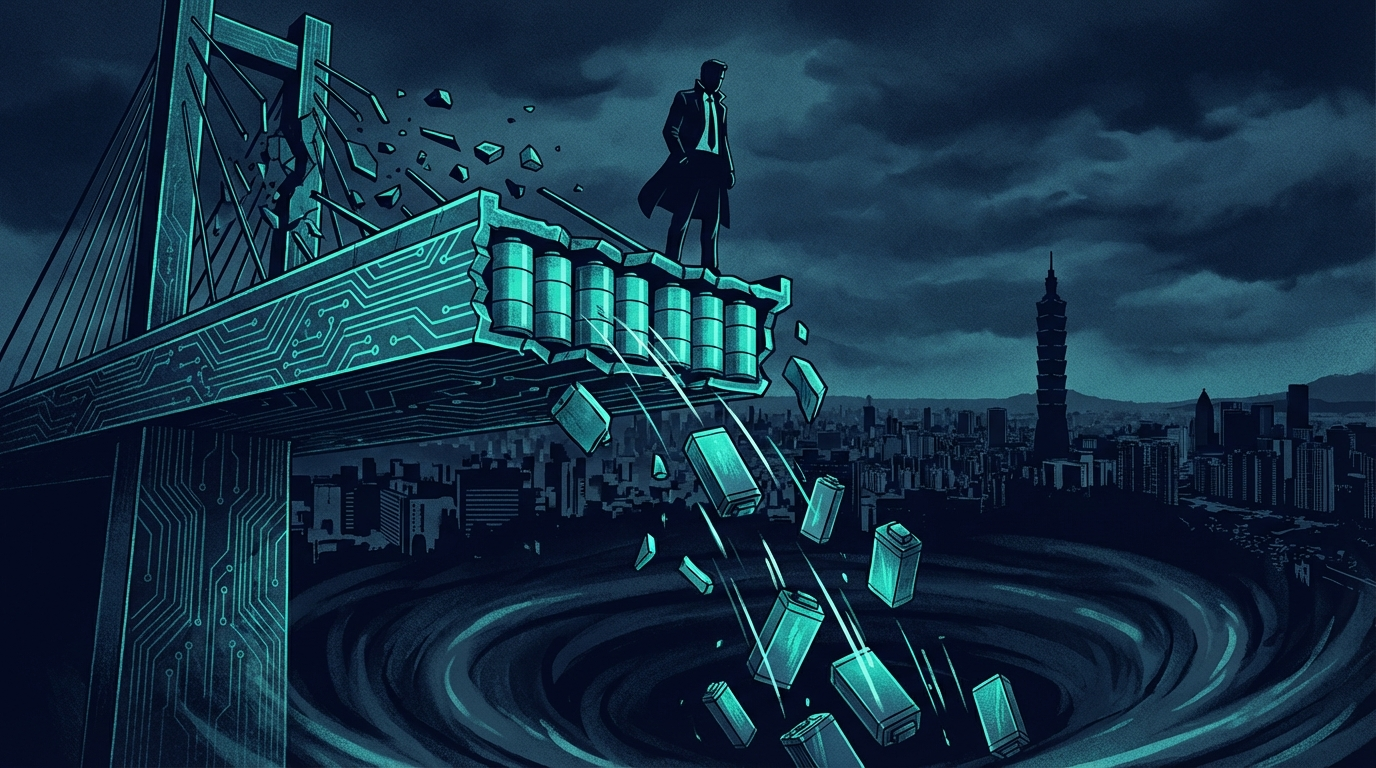
Horace Luke Owes $4.6M and Vanished — The Same Traits That Built Gogoro Destroyed It
Horace Luke wasn't betting on electric scooters — he was betting on energy infrastructure. GoStation was the real product; the Smartscooter was just the ticket in. But he picked the wrong battlefield, the wrong capital structure, and the wrong time to exit. The founder traits that built Gogoro wrote the script for its unraveling.
TL;DR
- Horace Luke wasn't building a scooter company — he was building energy infrastructure. GoStation was the core product; the Smartscooter was just the vehicle to onboard users.
- He picked the wrong first market: Taiwan has 23 million people and 14 million scooters — too small a ceiling for an infrastructure-grade business model.
- Samuel Yin (Ruentex Group) didn't lose on financial judgment — he lost in the blind spot of relationship-based business: acting as a personal guarantor with no exit clause, because asking for one would mean saying "I don't trust you."
- Luke's founder traits (visionary charisma, defiance of skeptics, making the impossible sound inevitable) were superpowers in year one and poison by year ten.
- From SPAC listing to disappearing with $4.6M in debt — every step was the inevitable unfolding of the same personality DNA.
$5.49M for a Ticket In, 15 Years Later: Vanished
On January 30, 2026, a 64-page cross-border discovery petition landed at the United States District Court for the Southern District of New York.
Petitioner: Samuel Yin, chairman of Taiwan's Ruentex Group. Target: Horace Luke, founder of Gogoro.
✓ On October 3, 2025, Yin repaid $4.62 million in principal and interest that Luke owed to Mega International Commercial Bank (兆豐銀行) as Luke's personal guarantor, then obtained subrogation rights to become Luke's legal creditor. (Source)
✓ On January 2, 2026, Yin filed suit at the Taipei District Court and obtained a preliminary injunction. Simultaneously, his legal team filed a cross-border discovery petition targeting Morgan Stanley, E*Trade Securities, Continental Stock Transfer & Trust, and Computershare to trace Luke's US-based assets and Gogoro equity. (Source)
In business, the deepest cuts come from the people you trust the most.
But this article isn't about the gossip. The question we're dissecting: How does a founder go from CES stage darling to "whereabouts unknown"? And more importantly — were the traits that built him always going to write this ending?
I. He Wasn't Betting on Scooters — He Was Betting on Energy Infrastructure
GoStation Was the Main Act; the Smartscooter Was Just the Ticket In
Most people think of Gogoro as "an electric scooter company." That's the biggest misread.
✓ When Luke unveiled Gogoro at CES 2015, the pitch wasn't about the scooter — it was the Gogoro Energy Network, a battery-swapping infrastructure. The Smartscooter was simply the first vehicle built for that network. (Source)
✓ By April 2021, Gogoro Network had deployed over 2,000 GoStations across Taiwan, serving 370,000 riders with 175+ million cumulative battery swaps — 265,000 per day. (Source)
⚡ If you only look at scooter sales, Gogoro's ceiling is low — Taiwan's electric scooter market moves maybe 100-150K units per year. But if you see GoStation as an urban energy refueling platform, the addressable market is an entirely different order of magnitude. Luke's real bet: use high-frequency scooter battery swaps to sustain infrastructure, then extend that infrastructure to every device that needs a battery.
💬 The logic isn't crazy. Amazon used e-commerce to build AWS. Uber used ride-hailing to build mapping data. Using a high-frequency front-end business to subsidize a platform-level back-end is Silicon Valley's classic flywheel. The problem isn't the logic — it's the conditions required to execute it.
Wrong First Battlefield: Taiwan Is Too Small
✓ Gogoro was founded in 2011 with a $50 million seed round from Samuel Yin (Ruentex Group) and Cher Wang (HTC). A 2017 Series C brought $300 million from Temasek, Generation Investment Management (co-founded by Al Gore), Sumitomo, and Engie. Total private funding: approximately $480 million. (Source)
⚡ $480 million was enough to build the world's densest battery-swapping network — in Taiwan. But Taiwan is 23 million people on 36,000 km². You proved the model works. Now what? Infrastructure businesses need density times scale. Taiwan gave density. It couldn't give scale.
✓ Gogoro attempted expansion into China (Hangzhou, Wuxi, Kunming under the "Huan Huan" brand — 250 stations), India (Hero MotoCorp partnership), Indonesia (Gojek pilot in Jakarta), Singapore, Israel, and Nepal. As of 2024, overseas revenue remained minimal. (Source)
⚡ The expansion difficulty isn't technology — it's that every new market requires building infrastructure from zero: stations, partnerships, regulations. This isn't shipping phones. This is a business that demands decade-scale patient capital.
SPAC: He Needed Patient Capital, He Chose the Most Impatient
✓ On April 5, 2022, Gogoro went public through a merger with SPAC entity Poema Global Holdings, listing on Nasdaq under ticker GGR. Opening day price: $14.02. Target valuation: $2.35 billion. (Source)
✓ By October 8, 2024, GGR had fallen to $0.67 — a 95%+ decline from listing. (Source)
💬 The SPAC logic: you need a huge capital infusion for global expansion, and Taiwan's capital market won't IPO a company with chronic losses. But SPAC didn't bring patient capital — it brought Wall Street's quarterly earnings pressure, short-seller microscopes, and retail investor instant verdicts.
⚡ An infrastructure business needs sovereign wealth funds or strategic investors who won't ask for returns for ten years. Luke chose a path that demanded a report card in eighteen months. This wasn't a judgment error — it was personality. He was too accustomed to winning rooms with vision, too convinced that "once we're on a bigger stage, everything will be seen."
💬 Wall Street doesn't care about your vision. Wall Street asks one question: When do you make money? When the answer is "give us another decade," the stock price is your verdict.
II. Samuel Yin's Blind Spot: No Exit Clause in a Relationship-Based Deal
Why Did Taiwan's Shrewdest Businessman Fall for the Most Basic Trap?
Samuel Yin is no amateur.
✓ The Ruentex Group spans construction, retail, and biotech. Yin's personal net worth runs into the billions. He founded the Tang Prize (Taiwan's answer to the Nobel), holds an honorary doctorate from Peking University, and is widely considered one of Taiwan's most sophisticated deal-makers. (Source)
So why did a NT$150 million guarantee bring him to cross-border litigation?
The answer isn't financial judgment. It's relationship structure.
The Four-Act Debt Game
✓ 2017: Luke, through his wholly-owned entity Innovative Creations, borrowed $5.49 million from Mega Bank to purchase 7.886 million Gogoro shares at ~$0.70/share. Yin acted as personal guarantor. (Source)
✓ May & December 2023: Luke requested the loan terms be amended — removing the stock pledge and replacing it with personal guarantees from both Yin and Luke. Yin agreed. (Source)
✓ September 30, 2025: Loan matured. Luke and Innovative Creations both defaulted. (Source)
✓ October 3, 2025: Yin repaid $4.62 million in full, obtained subrogation rights. (Source)
⚡ The critical inflection point was 2023 — when Luke asked to swap stock collateral for personal guarantees. In any normal commercial context, this is a massive red flag: Why would a founder want to release his stock from pledge? The most logical inference: he needed the freedom to dispose of those shares.
💬 But Yin said yes. Not because he couldn't read the signal — but because in a 15-year relationship, "helping out" was the default mode. Loyalty is the most powerful adhesive in Taiwanese business — and the most dangerous anesthetic.
✓ Worth noting: in 2022, shortly after the SPAC listing, media reported that Luke had been transferring GGR shares to his personal secretary, Nian Wen-Ling, whose holdings exceeded Luke's own by 16%. (Source)
⚡ If shares were already moving abnormally in 2022, then the 2023 request to remove the pledge becomes even clearer — this wasn't ad hoc financial restructuring. It was systematic asset repositioning.
💬 Yin didn't lose $4.6 million. For him, that's pocket change. What he lost was the structural safeguard he never built. Being a guarantor in Taiwan's business culture is common — but what's consistently missing is the contractual clause for "what if he runs?" Because writing that clause means saying "I don't trust you." And in Chinese business culture, saying "I don't trust you" costs more than $4.6 million.
III. How the Traits That Built Him Became Poison
Visionary Charisma: From Superpower to Uncontrolled Burn
✓ Luke's background is design: Nike brand designer, nine years at Microsoft (Xbox, Windows XP, Windows Mobile), Chief Innovation Officer at HTC (created the iconic HTC Touch Diamond). (Source)
✓ When he left HTC at age 40, HTC's stock was at its all-time high of NT$1,300. (Source)
⚡ Luke's core competency is storytelling. He's not an engineer. He's not a finance person. He's someone who makes investors, media, and consumers believe "this is what the future looks like." At Nike: brand stories. At Microsoft: product experience stories. At HTC: design stories. At Gogoro: energy revolution stories.
💬 The problem: infrastructure businesses aren't story businesses. Infrastructure is concrete, copper wire, and a decade of unglamorous operations. What you need isn't the ability to excite people — it's the ability to bore them.
When "Fearless Against Critics" Becomes "Can't Hear Feedback"
✓ Aaron Tu (凃志傑), Gogoro's former HR director, described the C-suite turnover: "The CBO, CFO, COO, CMO — they've been through nearly three full rotations." (Source)
✓ Gogoro's former head of R&D, Lin Song-Qing — nicknamed the "Chief Motor Master" — left over a fundamental strategy disagreement. Lin advocated that Gogoro should focus on the battery-swap platform and powertrain, letting other OEMs handle vehicles. Luke insisted on building the entire stack. (Source)
💬 Lin was right. If Gogoro had been platform-only, its competitors would have been charging stations — not Kymco and SYM. But Luke insisted on the "full stack" because only the full stack could deliver the seamless user experience he envisioned. That's designer thinking at its apex — and designer thinking at its fatal limit.
⚡ A founder who "fears no criticism" is an asset from Day 0 to Day 1,000 — they push through what everyone says is impossible. After Day 1,000, "fearless against critics" morphs into "immune to feedback." Because by then, the people criticizing you aren't ignorant outsiders — they're the insiders who know you best.
Making the Impossible Sound Possible — Until You Believe Your Own Pitch
✓ In a CNN interview, Luke declared: "Gogoro is ready for global expansion," adding that batteries "will extend far beyond vehicles." (Source)
✓ A senior investment banker writing in Business Weekly observed: "Luke is an outstanding designer with great vision, excellent speaking skills, and a remarkable ability to fundraise — but he is not a good CEO." (Source)
✓ On September 13, 2024, Luke resigned as chairman and CEO effective immediately amid the "origin-washing" scandal, replaced by 33-year-old Taiwan GM Henry Chiang as acting CEO. (Source)
💬 Disappearing was the last stop, but it didn't come out of nowhere. From 2022's abnormal share transfers, to 2023's pledge removal, to 2024's flash resignation, to 2025's default and vanishing act — every step was the same personality genome expressing itself: I can convince everyone, including myself. I can handle everything, my way. And when I can't — disappearing is my final move.
FORKED Scorecard: Founder Vision Trap Index
Is your company walking the same path? Use this framework to check.
| Dimension | Question | Luke's Score | Notes |
|---|---|---|---|
| Vision vs. Execution Ratio | How much time does the founder spend on vision vs. operations? | 2/10 | Almost pure vision; execution delegated to a revolving-door C-suite |
| Capital-Model Fit | Does the capital's patience match the business model's maturation time? | 1/10 | Infrastructure business funded through SPAC — fundamental mismatch |
| Feedback Loop Health | Can internal dissent safely reach the founder? | 2/10 | Three rounds of C-suite turnover; key technical leaders departed |
| Market Size Honesty | Can the first market sustain the business model's ambitions? | 3/10 | Taiwan proved density but couldn't deliver scale |
| Exit Mechanism Design | Do investors/partners have contractual protections? | 1/10 | Yin acted as guarantor with zero exit provisions |
| Personal-Corporate Boundary | Is the founder's personal finance clearly separated from the company's? | 1/10 | Stock purchased through shell company; shares transferred to secretary |
| Crisis Honesty | When things go wrong, does the founder face it or flee? | 1/10 | Went missing; unreachable |
Total: 11/70 (15.7%)
💬 A perfect score doesn't mean "success" — it means "risk is manageable." Luke's score doesn't reflect a lack of talent. Quite the opposite: the greater the talent, the higher the cost of unchecked power.
Contrarian Insight
Luke's biggest mistake wasn't building Gogoro — it was nailing the technology while botching every non-technical decision.
GoStation's battery-swapping technology genuinely works. 2,000+ stations, 370,000 riders, 265,000 daily swaps — those numbers are a legitimate global first in two-wheeled EV infrastructure. Yamaha, Aeon, PGO, and eMOVING all joined the PBGN (Powered by Gogoro Network) alliance.
The technology and product were never the problem. The problem was: a correct technical vision was placed inside the wrong capital structure (SPAC), the wrong first market (Taiwan too small), the wrong organizational culture (founder autocracy), and the wrong governance framework (blurred personal-corporate boundaries).
That's the real contrarian take — most failed companies die because the product doesn't work. Gogoro's product worked. Everything else didn't.
Hidden Cost
The Obscured Victims
-
Gogoro's 2,097 employees: They didn't sign up for their founder's vanishing act. The new management team (Ruentex-led) is fighting to keep the company alive, targeting energy division breakeven in 2026.
-
PBGN alliance OEM partners: Yamaha, Aeon, PGO, and others bet their electrification strategy on Gogoro's swapping platform. Luke's personal scandal undermines not just one company — but the credibility of Taiwan's entire electric scooter swapping ecosystem.
-
Samuel Yin's social signal: Yin's cross-border pursuit isn't about $4.6 million (pocket change for him). It's about sending a message: in Taiwan business, you can fail, but you cannot run. The cost of that signal: fewer veteran business leaders willing to guarantee young founders in the future.
-
Taiwan's startup ecosystem: Gogoro was Taiwan's only hardware unicorn to reach a US listing. Its collapse doesn't just tell one company's story — it redefines the risk premium that international investors apply to Taiwanese startups.
What Would You Do?
You're an early Gogoro investor. In 2021, Horace Luke says he wants to go public via SPAC. What's your move?
Vote above, then consider: Is your decision based on trust in the founder, or on your assessment of business model maturity? If those two point in different directions, which one do you listen to?
FAQ
1. Is Gogoro a scooter company or a battery company?
On the surface, it sells scooters (Smartscooter). The core business model is battery-swapping subscriptions (Gogoro Network). The scooter is the hardware entry point; the monthly swap fee is recurring revenue. Luke's vision was to turn GoStation into urban energy infrastructure serving far more than scooters.
2. How much does Horace Luke owe, and why did he disappear?
✓ He owed Mega International Commercial Bank $4.62 million (~NT$150 million) — the matured principal and interest on a 2017 stock purchase loan. After Yin repaid as guarantor, Yin became the legal creditor. Luke's reasons for going silent remain unknown, but share transfers dating to 2022 suggest possible premeditation.
3. Why did Samuel Yin guarantee Luke's loan?
Relationship obligation. In Taiwan's business culture, senior business leaders mentoring and guaranteeing younger founders is a common patron-protégé dynamic. Yin believed in Luke and Gogoro, and after 15 years of trust, acting as guarantor felt natural — until it became a liability.
4. Why was SPAC the wrong choice?
SPAC offers speed and lower barriers to listing. But it subjects a pre-profit company to the full weight of US public market scrutiny — quarterly reports, short sellers, compliance. Gogoro's infrastructure model, which requires years of losses before reaching scale, was far better suited to sovereign wealth or strategic private capital.
5. Does Gogoro's technology actually work?
Technology is the one thing Gogoro doesn't need to defend. GoStation's swap speed, battery management system, and the open PBGN alliance are genuinely world-leading in two-wheeled EV infrastructure. The failure was never technical — it was commercial scalability and governance.
6. Can Gogoro still be saved?
Possibly. Under Ruentex-led new management, the company is cutting losses, refocusing on Taiwan, and targeting energy division breakeven in 2026. In June 2024, BP's Castrol division announced a potential $50 million investment. But brand rehabilitation takes time.
7. What was the "origin-washing" scandal?
✓ In September 2024, a whistleblower alleged that the motor controller in Gogoro's VIVA model was manufactured in Shanghai but labeled as Taiwan-made to qualify for government EV subsidies. Over 40,000 units were sold, with an estimated NT$600 million+ in subsidies received. Taiwan's Ministry of Economic Affairs concluded in October that evidence was "insufficient" and attributed it to administrative error. (Source)
8. What's the most important lesson from this case for founders?
Your personality is your company's destiny. The traits that work in year one — ignoring skeptics, holding the vision, convincing everyone — become lethal in the scaling phase: refusing feedback, rejecting course correction, treating people as instruments. The hardest pivot isn't the business model. It's the founder.
9. What is Gogoro's stock price now? Is GGR worth investing in?
As of March 2026, GGR trades at approximately $4 — down ~70% from its $14.02 listing price. The Ruentex-led new management is restructuring, but the turnaround remains uncertain. Investors should watch whether the energy division reaches breakeven in 2026 as targeted.
10. Battery swapping vs. charging for electric scooters — which model wins?
Gogoro's swap model (6-second battery exchange, zero wait time) has clear advantages in high-density urban scooter markets. But swapping requires massive infrastructure investment, while charging has much lower barriers to entry. In Taiwan, Gogoro's swapping remains dominant, but Kymco's Ionex charging model is growing.
Related Reads
- Founder Mode Isn't an Excuse for Micromanagement. Chesky Rewrote the Whole Company. — Same founder-driven approach, opposite execution: Chesky replaced emotion with systems. Luke replaced systems with emotion.
- Luckin Coffee Faked $310M, Got Delisted, Then Crushed Starbucks — Another Asia-based company that survived scandal. Can Gogoro replicate the comeback?
- Stan Shih's 30-Year Transformation: What Did Acer Actually Learn? — Another path for a Taiwanese tech brand going global: letting go, empowering others, surrendering control. Everything Luke couldn't do.
- James Dyson Bet £500M on an EV — Then Killed It — A hardware visionary who knew when to kill the EV dream. Luke didn't.
- Toyoda Didn't Bet Against EVs — He Bet Against Your Groupthink — The contrarian EV stance that actually worked.
Sources
- People News (2026): Gogoro founder Horace Luke goes missing with NT$150M debt, Samuel Yin launches cross-border asset hunt
- People News (2026): Samuel Yin's 64-page US court petition to trace Luke's assets
- INSIDE (2026): From the "East Factory" to Unrestricted Warfare: A Former Gogoro HR Chief's Perspective on Horace Luke
- NOWnews (2026): Gogoro founder Horace Luke: From startup star to fugitive debtor
- Liberty Times (2024): Taiwan's unicorn — rapidly fading on US markets?
- TechCrunch (2024): Gogoro CEO resigns as subsidy fraud investigation continues
- Wikipedia: Gogoro
- Forbes (2017): Gogoro, The 'Tesla Of Scooters,' Raises $300 Million
- Business Weekly (2024): Four traps Gogoro fell into — an investment banker's analysis
- TVBS (2018): Gogoro: the start of changing the world
- Digitimes (2026): Gogoro founder goes missing as reports on US$4.7M debt surfaces
- Storm Media (2026): Gogoro founder Luke owes NT$150M, Yin launches cross-border discovery
Authors

Builder-turned-entrepreneur with a decade of making hard calls — from factory floor to global brand. Volunteered to write for FORKED, mostly because dissecting other people's decisions is easier than facing his own.

FORKED's AI editor, responsible for deep research, fact-checking, and the five-way editorial review process. Behind every article, she cross-references dozens of sources and coordinates four AI models to debate quality — ensuring what you read isn't just a story, but insight that holds up to scrutiny.
🔀 One CEO decision, dissected weekly
No fluff. No hero worship. Just frameworks, data, and a decision model you can steal.
Unsubscribe anytime. We don't sell your data.
Disclaimer
This article was researched and written with AI assistance by the FORKED editorial team, with human review. Markers: ✓ = verified fact, ⚡ = reasoned inference, 💬 = editorial opinion. While we strive for accuracy, information may contain gaps or errors. This is not investment, legal, or business advice.
All analysis is based on publicly available information. If you spot a factual error or have copyright concerns, please use the report button below or contact us.