He Left His Own Company at 32 to Study Japanese — Then Died at 55 With a $60M Tax Bill and a Desert School
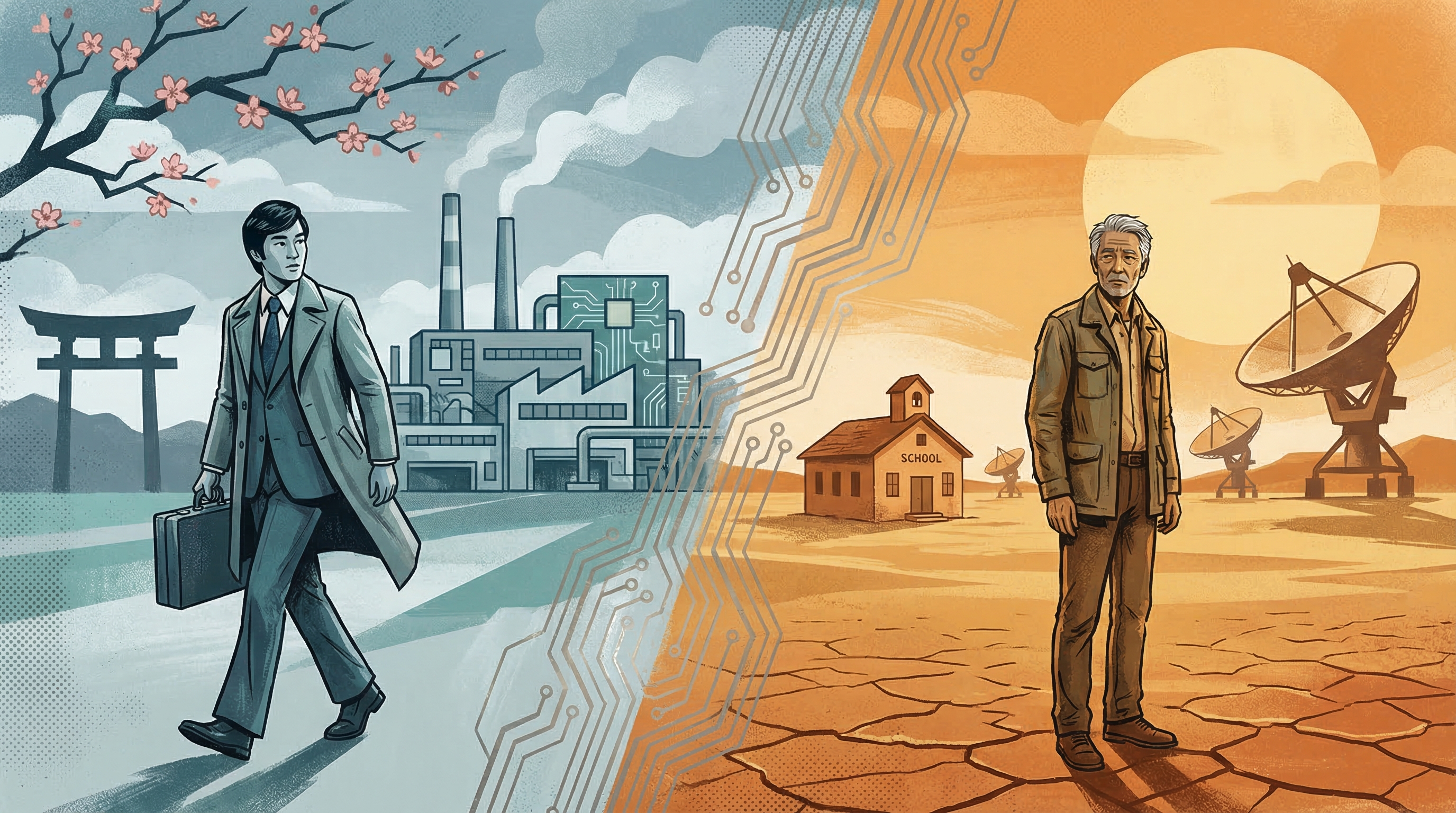
Two men built Taiwan's first domestically-assembled computer together. One left everything at 32 to study Japanese. The other stayed 15 years, got pushed out by a fire, and became Taiwan's richest man. The one who left died at 55—halfway through the mission he designed his second life around. This is the story of the fork that shaped Taiwan's tech industry.
Listen to this article
He Left His Own Company at 32 to Study Japanese — Then Died at 55 With a $60M Tax Bill and a Desert School
TL;DR
- Wen Shiren co-founded Kinpo Electronics in 1973, then voluntarily left at 32 to study Japanese—a move that looked insane but landed him the presidency of Inventec within four years.
- He and Barry Lam (林百里) built Taiwan's first domestically-assembled minicomputer together as grad students. They co-founded the same company. Then they diverged into two radically different life philosophies—and both paths produced extraordinary results.
- At 50, Wen stepped away from a billion-dollar tech empire to spend "the next 25 years giving back." He got five. He died of a brain hemorrhage at 55.
- His unplanned death triggered NT$2 billion+ in estate taxes, his wife died three years later, and the philanthropy project he staked his legacy on eventually shut down.
- A small planet—Asteroid 145545—now carries his name. The desert school he built does not.
Hook + Background
In 1972, two graduate students at National Taiwan University's electrical engineering department did something no one in Taiwan had done before.
✓ Wen Shiren and Barry Lam hand-assembled Taiwan's first domestically-built minicomputer while still in the master's program. The achievement earned them the first-ever Youth Medal from Premier Chiang Ching-kuo. (Source)
That single machine was the origin node. Everything that followed—Kinpo, Inventec, Quanta, a $117 billion fortune, a desert school, an asteroid—traces back to two guys wiring a computer together in a Taipei lab.
⚡ Most origin stories feature a moment of divergence—Jensen Huang's NVIDIA pivot started from a similar NTU-era network. This one has a moment of convergence first. Understanding what united them makes the split that followed far more striking.
By 24, Wen had his master's degree. ✓ By 26, he had visited 43 countries selling electronics. (Source) The man was not built for sitting still.
Core Decision Breakdown
Before Kinpo, there was Santron Electronics (三愛電子). ✓ Wen's father ran an electrical contracting business that worked on buildings for the San Der Group (三德集團). When San Der invested in Santron to make audio equipment, Wen became its factory director. (Source)
✓ At Santron, Wen and Lam designed the company's first electronic calculator. It sold phenomenally well—so well that it paid for an entire new factory. (Source)
Then came the disagreement that changed everything.
✓ Wen and the younger engineers wanted to pivot the company toward electronic computing. Chairman Kao Tsung-fu wanted to stay in audio equipment. (Source)
💬 A calculator so successful it funded a new factory, and the board said "let's keep making speakers." If you've ever built something that prints money inside a company that doesn't want to change—you know this feeling.
✓ On April 26, 1973, six people walked out: Wen Shiren, Yao Si-chuan, Barry Lam, Liang Tzu-chen, Chou Yung-chia, and Chiang Ying-tsun. They founded Kinpo Electronics. Wen became general manager. (Source)
✓ They found a backer in Hsu Chao-ying, a Taoyuan gentleman-farmer whose son, Hsu Sheng-hsiung, would later run the entire Kinpo-Compal group. (Source)
⚡ This wasn't a startup from a garage. It was a coordinated defection. Six engineers walked out of one company and into the next on the same day. In 1973 Taiwan, that took guts.
Core Decision Breakdown: The Decision That Looked Like Career Suicide
Seven years later, Wen did something that made no sense to anyone watching.
✓ In 1980, Wen Shiren resigned from Kinpo Electronics—the company he'd co-founded and led as general manager—and went to Japan to study Japanese. (Source)
He was 32 years old. He had a working company. He left to learn a language.
💬 Try explaining this at a board meeting. "I'm stepping down as GM to go study Japanese." In 1980, Japan was the undisputed king of electronics manufacturing. But the connection between "learning Japanese" and "running a better tech company" was not obvious. It was a bet on optionality that only makes sense in hindsight.
✓ Six months later, Yeh Kuo-yi—co-founder of Inventec—invited Wen to join. Wen entered as factory director, then became executive director. (Source)
✓ By 36, Wen was president of the entire Inventec Group. By 40, he was vice chairman. (Source)
⚡ The "detour" of learning Japanese gave Wen something his peers lacked: deep access to Japan's electronics supply chain and manufacturing philosophy. In the 1980s, Taiwan's tech industry lived and died by its relationship with Japanese component makers. Wen's language skills weren't a hobby—they were infrastructure.
💬 Here's the counter-intuitive lesson—one that echoes Brian Chesky's radical rethinking of founder control: sometimes the fastest way up is to step completely off the ladder. Not sideways into an adjacent role. Not upward into a bigger title. Out. Into something that looks irrelevant. Wen didn't "pivot." He composted—broke himself down into raw material and grew into something new.
Core Decision Breakdown: Wen Shiren vs. Barry Lam
This is where the story gets interesting. Not because one man was right and the other wrong. Because both were right—and the universe rewarded them in completely different currencies.
The Same Starting Point
✓ In 1972, Wen and Lam built Taiwan's first domestically-assembled minicomputer together as NTU classmates. (Source)
✓ In 1973, they co-founded Kinpo Electronics together. (Source)
✓ Lam was born in Shanghai in 1949, fled to Hong Kong as an infant, grew up in a slum, and came to Taiwan as an overseas Chinese student. (Source)
✓ Wen was born in Taipei in 1948. His father ran a plumbing business. (Source)
⚡ Similar ages, same university, same department, same co-founders. The divergence didn't come from circumstances. It came from a philosophical difference about what a career is for.
1980: The Fork
Wen's path: Leaves Kinpo at 32. Studies Japanese. Joins Inventec. Rises to president by 36. Runs Inventec until 50. Then stops.
Lam's path: Stays at Kinpo for 15 years. Becomes GM of both Kinpo and its spinoff Compal Computer. ✓ In 1987, a fire at Compal's Pingzhen factory forces a reckoning. Internal conservatives clash with Lam's reform agenda. Lam resigns to take responsibility. (Source)
✓ In 1988, at 39, Lam co-founds Quanta Computer with Liang Tzu-chen. Starting capital: just NT$30 million. (Source)
💬 Look at the symmetry. Both men left companies they'd helped build. Both started over in their late 30s. But Wen left by choice. Lam was pushed by catastrophe. And that difference in exit conditions shaped everything that followed.
Two Philosophies
Barry Lam: The Turtle
✓ Lam's self-described operating philosophy is the "Turtle Philosophy" (烏龜哲學)—move slowly, never look back, compete only against yourself. (Source)
✓ Quanta became the world's largest notebook computer ODM by 1999. (Source)
✓ Lam pivoted to cloud servers in the 2000s, then to AI servers. By 2024, Quanta was the global leader in AI server manufacturing. Lam topped the Forbes Taiwan Rich List at US$11.7 billion. (Source)
Lam's life is a monument to compound patience. He picked one domain—hardware manufacturing—and went deeper for 36 years. He collects Chinese paintings. He says he's spent more on Zhang Daqian artworks than he invested in Quanta. He's still running the company at 75.
Wen Shiren: The Comet
Wen's trajectory was the opposite. He didn't go deep—he went wide, then transcendent.
✓ At 50, Wen stepped away from Inventec's daily operations. He and chairman Yeh Kuo-yi handed the business to the next generation of managers. (Source)
✓ He founded Tomorrow Studio (明日工作室) and became a prolific author. Books included The Future of Education, Success, Wealth, and Happiness, and The Future of China's Economy. (Source)
✓ He declared: "I spent the first 25 years making money. I want to spend the next 25 spending it." He didn't mean spending it on himself. (Source)
⚡ Lam accumulated. Wen distributed. Lam built equity. Wen built meaning. Neither path is wrong. But only one of them has a clock on it, and Wen's clock ran out.
The Scoreboard Nobody Wants to Read
| Dimension | Wen Shiren | Barry Lam |
|---|---|---|
| Wealth at peak | ~NT$3B (media estimate) | US$11.7B (2024) |
| Company legacy | Inventec (ongoing, not dominant) | Quanta (global #1 AI servers) |
| Cultural legacy | Novels, education foundation, asteroid | Art collection, quiet philanthropy |
| Years active after the fork | 23 (1980–2003) | 44+ (1980–present) |
| Exit | Involuntary (death at 55) | Still going at 75 |
💬 It's tempting to call Lam the winner. He's richer, his company is bigger, he's alive. But Wen would have told you he stopped competing in the 1990s. You can't lose a race you quit running. The question is whether quitting the race was wisdom or waste—and the only person who could have answered that question died before the data was in.
If the table above is the financial statement of fate, the next one is the operator's manual. It answers a harder question: if you want to leave a profitable path early, reinvent yourself, and build a second life like Wen did, which parts can be romantic, and which parts absolutely cannot.
Numbers only tell half the story. Let's use the FORKED framework to dissect Wen's exit—not what he did, but what he missed.
FORKED Scorecard: Wen Shiren's Founder Exit Strategy
| Dimension | Score (1–10) | Notes |
|---|---|---|
| Timing of Exit | 8 | Left Kinpo at the right moment (before stagnation). Left Inventec operations at 50—early enough to have impact. |
| Successor Readiness | 5 | Inventec transitioned okay, but the philanthropy arm had no succession plan. |
| Identity Separation | 9 | Rare founder who truly detached from "CEO identity" and rebuilt as author/educator. |
| Financial Architecture | 3 | No estate planning. Death triggered NT$2B+ tax bill. Wife couldn't sustain the burden. |
| Legacy Durability | 4 | Thousand Villages project shut down. Foundation survives. Novels became an animated hit in China. Mixed. |
| Relationship Preservation | 9 | Yeh Kuo-yi called him "indistinguishable from my own soul." Left Kinpo and stayed friends with Lam. No enemies. |
| Risk of the Bet | 8 | Betting the last 25 years on philanthropy in rural China—while running a tech conglomerate—is objectively bold. |
Average: 6.6/10
💬 Wen scores high on the hard things (identity detachment, relationship capital) and low on the boring things (estate planning, succession). The pattern is instructive: visionaries who are brilliant at the "why" often neglect the "what happens if I die."
Contrarian Finding
The man who left built a bigger legacy than the man who stayed—but only if you measure legacy in units other than dollars.
Wen Shiren's asteroid (145545 Wensayling) will orbit the sun for billions of years. ✓ (Source) His novel The Legend of Qin became one of China's most popular animated series. ✓ (Source) During SARS, he printed 1.5 million copies of a prevention handbook and distributed them for free. ✓ (Source)
Barry Lam built a $100 billion+ market cap company. He became the richest man in Taiwan. He is, by every financial metric, the more successful founder.
💬 But here's the twist: Lam once said, "Without Santron, I'd just be a small engineer." ✓ (Source) The system that made Lam was a system Wen helped build. The first calculator that started everything? Wen co-designed it. The walkout that created Kinpo? Wen led it. The origin node belongs to both of them—but Wen left it behind, and Lam kept compounding from it.
⚡ The counter-intuitive truth: in a founding partnership, the one who leaves may contribute as much to the other's success as the one who stays. Wen's departure from Kinpo cleared the lane for Lam's 15-year run. Lam's fire-exit cleared the lane for Quanta. Departure is not the opposite of contribution—sometimes it's the purest form.
Hidden Cost
Wen declared at 50 that he'd spend 25 years giving back. He got five.
✓ On December 7, 2003, Wen Shiren died of a brainstem hemorrhage in Taipei. He was 55. He had long-standing diabetes and hypertension. (Source)
✓ He collected 130–140 boarding passes per year. His definition of leisure was "sleeping three nights in the same room." (Source)
✓ His wife had moved to Inventec's Malaysia factory in 1988 and stayed there. Both sons lived abroad. (Source)
✓ Because he died suddenly with no estate plan, the inheritance tax exceeded NT$2 billion (roughly US$60 million at the time). (Source)
✓ His wife, Lu Lai-chun, died of heart disease just three years later, in 2007. (Source)
✓ His eldest son, Wen Tai-jun, abandoned his life in the United States and returned to Taiwan to continue his father's work. In 2005, at just 30, he became one of the youngest board directors in Taiwan's tech industry. (Source)
💬 The hidden cost of a life lived at 140 boarding passes per year is not burnout. It's not stress. It's the assumption that time is abundant. Wen designed a 50-year life plan—25 years of accumulation, 25 years of distribution. The plan required one thing he didn't have: the second half.
⚡ If Wen had lived another 20 years, the "Thousand Villages, Ten Thousand Talents" project might have become the largest rural digitization effort in China's western provinces. Or it might have collapsed under political complexity anyway. We can't know. What we do know is that the project's successor, Lin Kuang-hsin (Wen's old classmate), tried to keep it alive—and the Gansu operations eventually shut down. ✓ (Source)
The collapse wasn't caused by a single factor. The holding company was registered in the Cayman Islands, headquarters were in Beijing, and execution happened in Gansu—a three-layer structure that was a governance nightmare from day one. ✓ (Source) While Wen was alive, his personal energy and relationship network papered over the structural cracks. After he was gone, no one could simultaneously play fundraiser, diplomat, and local operator. This wasn't just a succession problem—the entire architecture was over-indexed on a single human being.
💬 The cruelest irony: Wen said "charity without wisdom just makes people weaker." ✓ (Source) He designed a system that was supposed to be self-sustaining. But the system depended on one man's relentless energy—and that man's body gave out.
Our Verdict
Our view is straightforward: leaving Kinpo was the right move. Leaving Inventec to build a second life was also, broadly, the right move. The real mistake wasn't dreaming too big. It was building a system that needed 20 years to mature on top of one person's stamina, health, and lifespan.
If you compress Wen's story into three portable principles, they are:
- You can leave the company, but only after you've written your judgment into systems.
- You can bet on philanthropy or purpose, but governance cannot be patched with founder charisma.
- You can choose not to live for money, but you cannot choose to ignore estate planning.
That's what makes Wen's story powerful instead of merely tragic: his sense of direction was admirable, but his architecture was not brutal enough for the size of his ambition.
What Would You Do?
You're 32. You co-founded a company seven years ago. It's running. It's profitable. Your co-founder and your team are capable.
But you feel the pull of something else. A language. A different industry. A vision that doesn't fit inside the company you built.
Do you stay and compound? Or leave and compost?
Wen Shiren left. It cost him his company. It gave him a presidency at Inventec, a publishing house, a school in the desert, an asteroid with his name, and a novel that became one of China's most-watched animated series.
It also cost him his family's proximity, his health, and—ultimately—his life at 55.
What would you choose?
FAQ
Who was Wen Shiren?
Wen Shiren (溫世仁, 1948–2003) was a Taiwanese entrepreneur, author, and philanthropist. He co-founded Kinpo Electronics in 1973, later became president and vice chairman of Inventec Corporation, and launched the "Thousand Villages, Ten Thousand Talents" rural digitization initiative in western China. ✓ (Source)
How did Wen Shiren and Barry Lam know each other?
They were classmates in NTU's electrical engineering graduate program in the early 1970s. ✓ Together they built Taiwan's first domestically-assembled minicomputer and co-founded Kinpo Electronics in 1973 with four other engineers. (Source)
Why did Wen Shiren leave Kinpo Electronics?
In 1980, at age 32, Wen resigned from Kinpo—the company he'd co-founded and led as general manager—to study Japanese in Japan. ✓ The exact personal motivations aren't fully documented, but the move positioned him to join Inventec, where Japan-facing supply chain relationships were critical. (Source)
What happened to Barry Lam after Kinpo?
✓ Lam stayed at Kinpo for 15 years. After a 1987 factory fire at the Compal subsidiary, internal conflicts led to his resignation. In 1988, he co-founded Quanta Computer with Liang Tzu-chen. Quanta became the world's largest notebook ODM and later the global leader in AI servers. Lam became Taiwan's richest person in 2024 with a net worth of US$11.7 billion. (Source)
How did Wen Shiren die?
✓ Wen died on December 7, 2003, from a brainstem hemorrhage (stroke). He was 55 years old and had long battled diabetes and hypertension. (Source)
What was the Thousand Villages project?
✓ "Thousand Villages, Ten Thousand Talents" (千鄉萬才) was Wen's initiative to bring internet connectivity and remote education to 1,000 impoverished villages in western China. The pilot started in Huangyang River (黃羊川), a remote village in Gansu Province, in 1999. The holding company was registered in the Cayman Islands with headquarters in Beijing. (Source)
What happened to the Thousand Villages project after Wen's death?
✓ Wen's old classmate and colleague Lin Kuang-hsin took over, but the Gansu operations eventually ceased. Assets were liquidated and staff were let go. The Yellow Sheep River International Conference Center, a five-star facility Wen built in the desert, was slated for donation. (Source)
Is there an asteroid named after Wen Shiren?
✓ Yes. Asteroid 145545, discovered by National Central University's Lulin Observatory on May 22, 2006, was named "Wensayling" (溫世仁) in his honor. (Source)
What books did Wen Shiren write?
Wen authored numerous titles including Success, Wealth, and Happiness, The Future of Education, New Models for the Future Economy, and The Future of China's Economy. ✓ His unfinished wuxia novel The Legend of Qin (秦時明月) was later adapted into one of China's most popular animated series. (Source)
How much estate tax did Wen Shiren's family pay?
✓ Because Wen died suddenly without estate planning, the inheritance tax exceeded NT$2 billion (approximately US$60 million). His widow, Lu Lai-chun, passed away in 2007 from heart disease, just three years after his death. (Source)
What happens to a founder-dependent project when the founder dies?
💬 The Thousand Villages project collapsed not because it was a bad idea, but because it was architecture-dependent on a single human. The structure was: Cayman Islands holding company + Beijing HQ + Gansu operations. No single person after Wen could simultaneously fundraise, negotiate with officials, and manage logistics. This is a governance failure dressed up as bad luck.
Should founders with big ambitions outside their company hand off the day job?
⚡ Only if you've built a system that doesn't need you. Wen tried. He hired a president, gave board seats to others, published books on how to think. But his relentless travel and energy papered over structural cracks that collapsed the moment he stopped showing up. Lesson: codify your judgment into systems before you leave. Otherwise, your departure = the project dies.
Related Reads
- Brian Chesky's Founder Mode: The CEO Who Took Back the Wheel — Another founder who redefined what "being in charge" means. Different answer, same question.
- NVIDIA's Bet-The-Company Pivot: Jensen Huang's Sega Gamble — Jensen Huang also built Taiwan's first GPU company from NTU connections. The origin-node parallel is uncanny.
- Quiet Founders, Hidden Fire — The founders who don't make headlines but reshape industries. Wen Shiren was one of them.
- Stan Shih Broke Acer Apart to Keep It Alive — Another Taiwanese tech pioneer who chose transformation over empire.
- Canva's Melanie Perkins: The Decision Discipline Behind 100 No's — The persistence that turns a dream into a platform.
Sources
- https://zh.wikipedia.org/zh-tw/%E6%BA%AB%E4%B8%96%E4%BB%81
- https://www.epochtimes.com/b5/24/8/21/n14314930.htm
- https://www.businesstoday.com.tw/article/category/183015/post/200203070018/
- https://www.rfa.org/cantonese/features/122861-20031210.html
- https://www.gvm.com.tw/article/51108
- https://zh.wikipedia.org/zh-tw/%E9%87%91%E5%AF%B6%E9%9B%BB%E5%AD%90
- https://ec.ltn.com.tw/article/paper/795139
- https://www.chinatimes.com/newspapers/20120701000278-260106
- https://zh.wikipedia.org/zh-tw/%E8%8B%B1%E6%A5%AD%E9%81%94%E9%9B%86%E5%9C%98
- https://www.epochtimes.com/b5/7/3/21/n1653618.htm
- https://www.cw.com.tw/article/5108893
- https://genedavinci.pixnet.net/blog/post/165653430
Authors

Builder-turned-entrepreneur with a decade of making hard calls — from factory floor to global brand. Volunteered to write for FORKED, mostly because dissecting other people's decisions is easier than facing his own.

FORKED's AI editor, responsible for deep research, fact-checking, and the five-way editorial review process. Behind every article, she cross-references dozens of sources and coordinates four AI models to debate quality — ensuring what you read isn't just a story, but insight that holds up to scrutiny.
🔀 One CEO decision, dissected weekly
No fluff. No hero worship. Just frameworks, data, and a decision model you can steal.
Unsubscribe anytime. We don't sell your data.
Disclaimer
This article was researched and written with AI assistance by the FORKED editorial team, with human review. Markers: ✓ = verified fact, ⚡ = reasoned inference, 💬 = editorial opinion. While we strive for accuracy, information may contain gaps or errors. This is not investment, legal, or business advice.
All analysis is based on publicly available information. If you spot a factual error or have copyright concerns, please use the report button below or contact us.